


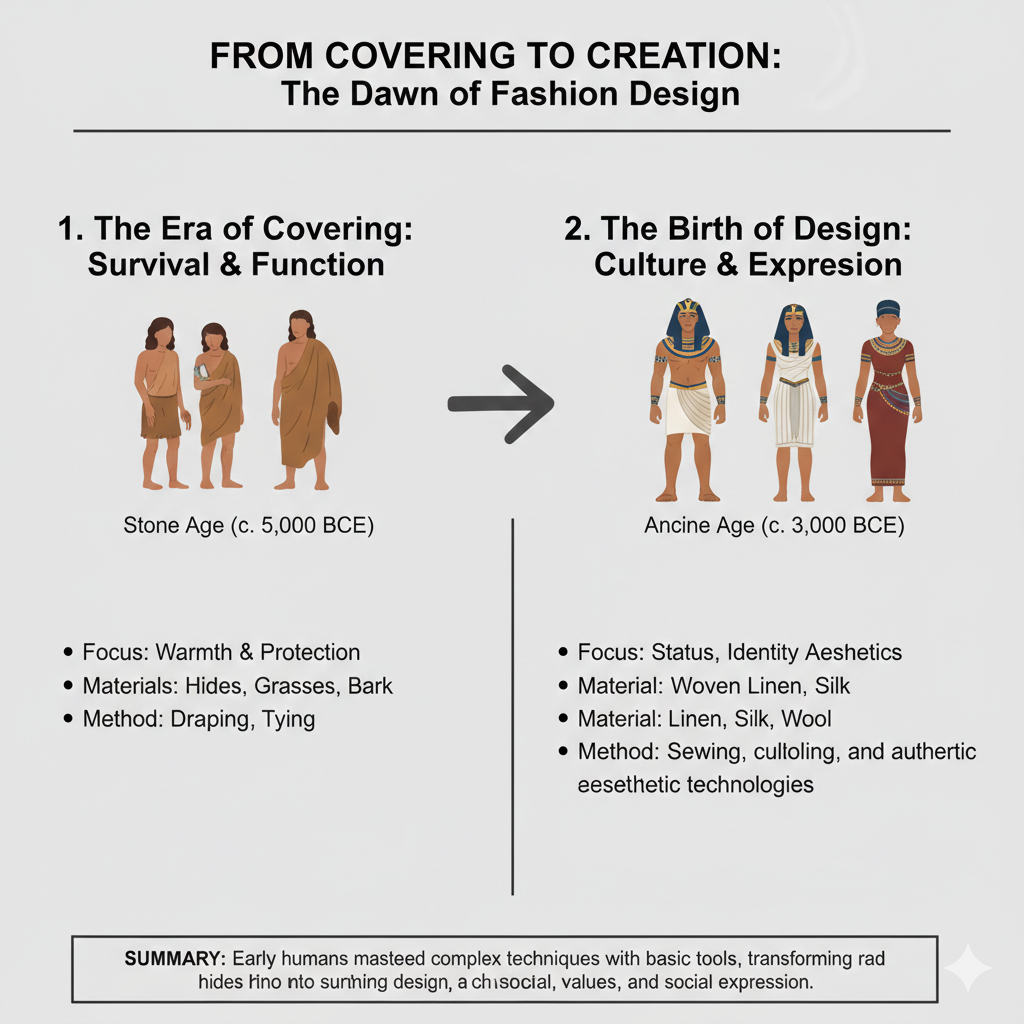
Clothing didn’t begin as fashion. It started as survival—animal hides draped over shoulders, plant fibers wrapped around hips. But somewhere along the timeline of human history, something shifted. People stopped simply covering their bodies and started shaping what they wore. They began to stitch, drape, and embellish with intention. The question is: when did this transformation happen?
Understanding this shift requires looking beyond the practical motivations behind why humans started wearing clothes. It’s about tracing the moment when clothing became a canvas for creativity, identity, and cultural meaning. This wasn’t a sudden change but a gradual evolution influenced by technological advances, social structures, and the human desire for expression.
The journey from function to form offers insight into how our ancestors thought, communicated, and connected. It reveals the earliest sparks of design thinking—a concept that would eventually lead to the elaborate fashion systems we recognize today. By examining archaeological evidence, anthropological research, and the development of textile techniques, we can pinpoint the milestones that mark this pivotal transition in human culture.
Early Signs of Design Thinking in Clothing
The leap from covering to designing wasn’t instantaneous. It happened incrementally, as humans began to recognize that what they wore could communicate more than just protection from the elements. Early signs of intentional design appear in subtle details: decorative patterns, specific cuts, and the choice of materials that went beyond mere availability.
Decorative Elements and Symbolism
Long before people stitched garments with defined shapes, they adorned their bodies. Archaeological findings suggest that body decoration before clothing played a significant role in early human societies. Shell beads, ochre pigments, and carved ornaments date back tens of thousands of years, indicating that humans valued visual expression early on.
These decorative impulses eventually transferred to clothing. Simple garments made from animal skins or woven plant fibers began to feature intentional embellishments—dyed sections, sewn-on shells, or carved bone fasteners. Such additions weren’t necessary for warmth or coverage, which suggests they served a different purpose: signaling identity, status, or group affiliation.
Symbolism in clothing also emerged as a tool for storytelling. Patterns and colors could represent clan membership, spiritual beliefs, or achievements within a community. This marks one of the earliest instances of clothing functioning as a designed object rather than just a protective layer.
Cultural Influence on Garment Shape
As human societies became more complex, so did their clothing. Different environments and cultural contexts shaped how garments were constructed. In colder climates, for instance, the need for insulation led to fitted garments that trapped body heat more effectively. In contrast, warmer regions saw the development of loose, breathable designs.
But climate alone doesn’t explain the diversity in garment shapes. Cultural values also influenced design choices. The role of modesty in early clothing played a part in determining what parts of the body were covered and how. In some societies, modesty dictated full coverage, while in others, partial covering was the norm. These choices reflect intentional design decisions rooted in social norms rather than pure functionality.
The act of choosing how to shape a garment—whether to drape, wrap, or stitch—demonstrates early design thinking. It shows that people understood clothing as something that could be crafted and refined, not just assembled from available materials.
Sewing Techniques That Enabled Structured Garments
The development of sewing was a game-changer. Before needles and thread, clothing consisted mainly of draped or wrapped materials. While these methods offered coverage, they didn’t allow for much structural integrity or customization. Sewing changed that, enabling garments to fit the body more precisely and hold specific shapes.
Archaeological evidence points to the use of bone needles as far back as 40,000 years ago. These tools, though simple, represented a significant leap in garment construction. With needles, people could pierce and join materials in ways that weren’t possible before. This allowed for the creation of tailored pieces that hugged the body, provided better insulation, and freed up movement.
The evolution of early sewing tools reveals a progression from crude bone awls to more refined implements made from ivory and metal. As sewing technology advanced, so did the complexity of garments. People began experimenting with different stitching techniques, learning how to reinforce seams, attach pieces at angles, and create openings for limbs.
The use of animal skins used in early garments also required sophisticated preparation and assembly. Skins had to be tanned, softened, and cut into workable pieces. Stitching them together demanded precision and an understanding of how materials behaved when joined. This process wasn’t just practical—it was creative. It involved planning, problem-solving, and an awareness of aesthetics.
Sewing enabled the birth of structured clothing. Garments no longer had to be shapeless wraps. They could follow the contours of the human body, accentuating or concealing specific features. This structural capability laid the foundation for what we now recognize as garment design.
The Birth of Silhouettes and Early Fashion Concepts
Once sewing became commonplace, the concept of a garment’s silhouette emerged. A silhouette refers to the overall shape and outline of a piece of clothing. It’s one of the most fundamental aspects of design, influencing how a garment looks and how it makes the wearer feel.
Understanding what is a clothing silhouette helps clarify why this was such an important development. A silhouette isn’t just the sum of fabric and stitching—it’s a deliberate composition. Early humans began recognizing that different shapes conveyed different meanings. A tightly fitted tunic might signal athleticism or status, while a flowing robe could represent authority or spirituality.
The creation of distinct silhouettes required an understanding of proportion, balance, and the relationship between fabric and body. It also required experimentation. Early garment makers tested different cuts, lengths, and volumes to see what worked. Over time, certain shapes became associated with specific functions or cultural roles, giving rise to recognizable garment types.
This development wasn’t isolated. It coincided with advances in textile production. The journey from fiber to fabric clothing process involved spinning, weaving, and dyeing—all of which opened new design possibilities. Woven fabrics, for example, allowed for more intricate patterns and textures than animal hides. They also offered greater flexibility in how garments could be constructed and draped.
The emergence of silhouettes marked a turning point. It showed that clothing had transcended its original purpose. People were no longer just covering their bodies—they were sculpting them. They were using fabric to create visual statements, express individuality, and participate in a broader cultural conversation about identity and aesthetics.
Transition Toward Ancient Civilizations and Fashion History
As human societies evolved into complex civilizations, so did their approach to clothing. The design principles that began in prehistoric times matured into sophisticated fashion systems. Ancient civilizations shaping clothing styles developed distinctive garments that reflected their values, technologies, and social hierarchies.
In ancient Egypt, for instance, linen garments were meticulously pleated and draped to create elegant, flowing silhouettes. The Greeks perfected the chiton and himation, garments that showcased the beauty of draped fabric. The Romans introduced the toga, a symbol of citizenship and status that required skill to wear correctly.
These garments weren’t just functional—they were deeply symbolic. They communicated wealth, power, profession, and social standing. The transition from early designed clothing to the elaborate wardrobes of ancient civilizations highlights how integral clothing had become to human culture.
The history of clothing evolution reveals a continuous thread of innovation. Each era built upon the discoveries of the previous one, refining techniques and expanding the possibilities of what clothing could be. Design thinking, which began as simple decoration and structural experimentation, evolved into a formal discipline that influenced architecture, art, and social organization.
This progression underscores an important truth: the shift from covering to designing wasn’t just about clothing. It was about humanity’s growing capacity for abstract thought, creativity, and cultural expression. Clothing became a medium through which people could explore identity, beauty, and meaning.
Designing Clothes as a Turning Point in Human Evolution
The moment humans started designing clothes instead of just covering their bodies represents a profound shift in cognitive and cultural development. It signaled an ability to think beyond immediate needs and consider aesthetics, symbolism, and social dynamics. This wasn’t merely about staying warm or protected—it was about becoming something more.
The human clothing evolution journey spans tens of thousands of years, marked by incremental innovations and creative breakthroughs. From the first decorative beads to the tailored garments of ancient civilizations, each step reflected humanity’s growing sophistication. Clothing became a tool for communication, a marker of identity, and a form of art.
Looking ahead, the future of human clothing in a digital world promises even more dramatic transformations. Technology is enabling new forms of design, from 3D-printed garments to smart fabrics that respond to environmental conditions. Yet the core impulse remains the same: the desire to shape what we wear in ways that reflect who we are.
The transition from covering to designing was more than a practical evolution. It was a creative awakening. It showed that humans are not just tool users or problem solvers—we are makers, storytellers, and artists. Clothing, in all its forms, is a testament to that enduring truth.