


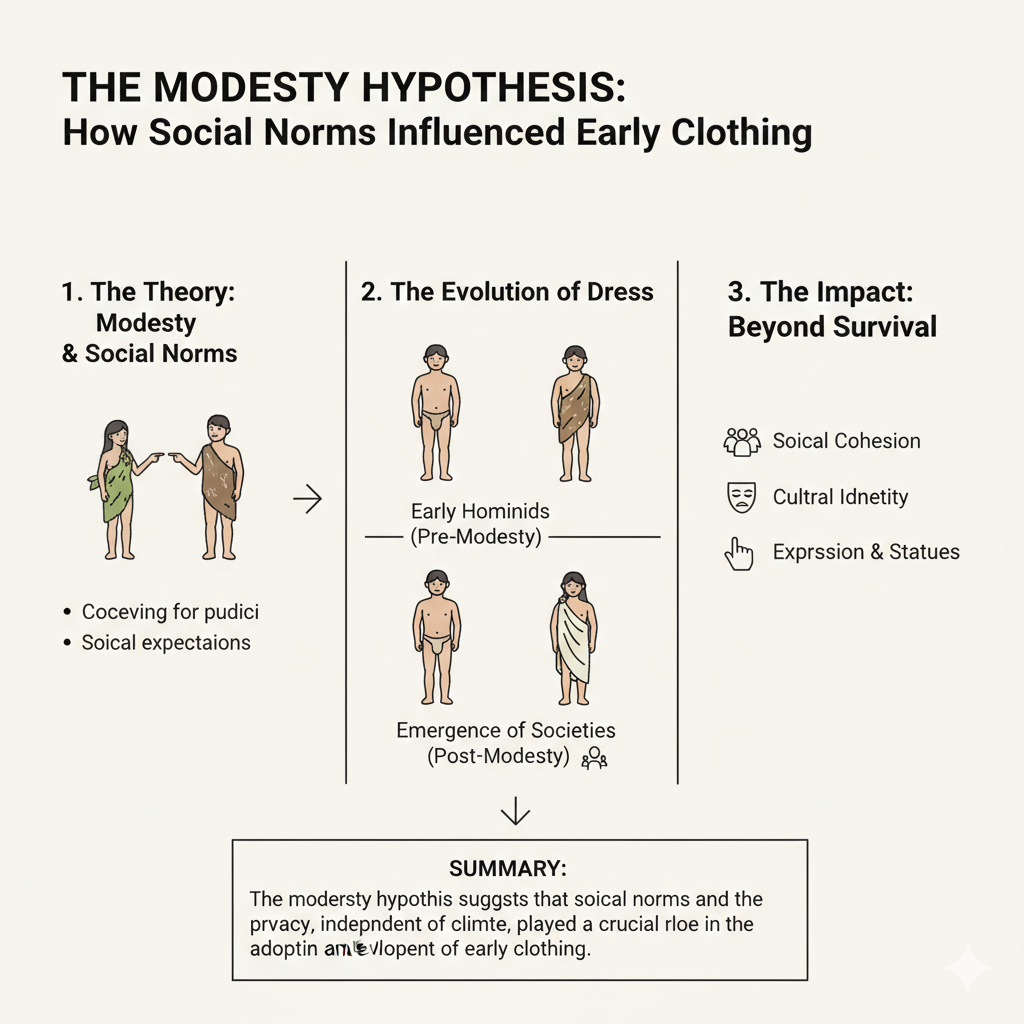
When we think about why humans first wore clothes, protection from the elements often comes to mind. Cold temperatures, scorching sun, and rough terrain all seem like practical reasons to cover up. But there’s another layer to this story—one that’s less about survival and more about how we saw ourselves and each other.
Modesty, as a social concept, may have played a surprising role in shaping early clothing traditions. While it’s difficult to pinpoint exactly when or why humans began associating nudity with shame or vulnerability, anthropological evidence suggests that clothing wasn’t just about keeping warm. It was also about signaling status, marking boundaries, and establishing group norms.
This blog explores how modesty influenced the earliest garments and shaped the way clothing evolved from basic coverings into symbols of identity, ritual, and culture. Understanding this connection helps us see why humans started wearing clothes not just as a survival instinct, but as a deeply social one.
Beyond Survival: The Social Side of Early Clothing
Early humans lived in small, tight-knit groups where social cohesion mattered as much as physical survival. In these communities, clothing likely served dual purposes: protecting the body and communicating something about the wearer.
Archaeological findings show that even the simplest garments—animal hides, plant fibers, woven grasses—were sometimes decorated or arranged in specific ways. This suggests intentionality beyond mere function. People weren’t just covering themselves; they were presenting themselves.
Modesty, in this context, doesn’t necessarily mean shame. It might have been more about respect, differentiation, or readiness for certain social roles. Covering certain parts of the body could have signaled maturity, marital status, or participation in group rituals. In this way, clothing became a tool for organizing social life.
The relationship between climate vs culture in early clothing remains a topic of debate, but what’s clear is that humans didn’t wait until they migrated to colder climates to start dressing. Even in warm regions, people wore adornments and coverings that had little to do with temperature.
Understanding Modesty in Early Human Societies
Cultural Norms and Social Boundaries
Modesty is deeply tied to cultural norms, and those norms vary widely across time and place. What one group considers modest, another might find unnecessary or even strange. But the concept itself—setting boundaries around the body—appears to be universal.
In early human societies, these boundaries likely emerged as groups grew larger and more complex. As tribes interacted, competed, and formed alliances, visual markers became important. Clothing helped establish who belonged where and under what conditions.
For example, certain garments might have been reserved for elders, hunters, or women of childbearing age. These distinctions reinforced social hierarchies and made interactions more predictable. Modesty, then, wasn’t just about hiding—it was about revealing the right things to the right people at the right time.
This type of symbolic communication laid the groundwork for more elaborate clothing traditions. It also introduced the idea that the body could be a canvas for meaning, not just a vessel for survival.
Tribal Identity and Group Behavior
Clothing also played a role in distinguishing one group from another. Tribal identity was often expressed through specific styles, materials, or patterns. Wearing the “right” kind of covering signaled membership and loyalty.
Modesty reinforced these boundaries by creating visual codes that outsiders couldn’t easily replicate. If a certain garment or body covering was tied to a specific rite of passage, wearing it falsely could be seen as a violation of group norms.
This dynamic is still visible in modern clothing practices. From military uniforms to religious attire, what clothing says about identity continues to shape how we perceive ourselves and others.
In early societies, these practices were less formalized but no less powerful. A hunter might wear a specific animal pelt to signify skill. A healer might drape themselves in woven grasses to mark their role. These weren’t arbitrary choices—they were part of a shared language.
Anthropological Theories About Clothing and Modesty
Protection vs Social Expression
Anthropologists have long debated whether clothing emerged primarily for protection or social reasons. The truth is likely a combination of both, with the balance shifting depending on environment and culture.
In colder climates, survival needs would have dominated. But even in these regions, garments were often personalized or decorated in ways that suggest social motivations. A fur cloak might keep you warm, but the way it was stitched, dyed, or fastened could also communicate something about your place in the group.
Modesty fits into this framework as a social pressure that influenced garment design. If covering certain body parts became associated with respect or maturity, then clothing choices would reflect those values—even when warmth wasn’t a concern.
This dual function—practical and symbolic—helps explain why clothing traditions became so diverse. People adapted their garments to their environment, but also to their beliefs, relationships, and social structures.
Symbolism and Ritual Dress
Many early garments were tied to rituals and ceremonies. These events often required participants to wear specific coverings or adornments, reinforcing the idea that clothing was about more than everyday life.
Ritual dress introduced the concept of “appropriate” attire for specific contexts. You wouldn’t wear the same thing to a hunt as you would to a marriage ceremony. This distinction created a framework for modesty, where covering or revealing the body depended on the situation.
Over time, these practices became more codified. Ancient civilizations shaping clothing styles took these early ideas and expanded them into complex dress codes that governed everything from religious observance to political power.
But the roots of these traditions can be traced back to small groups of early humans who first decided that what you wore mattered as much as whether you wore anything at all.
Differences Between Functional and Symbolic Clothing
Not all early garments were created equal. Some were purely practical—rough hides or woven fibers meant to shield the body from harm. Others were symbolic, designed to convey meaning or mark a transition.
Modesty influenced both types, but in different ways. Functional clothing might cover vulnerable areas to prevent injury, while symbolic clothing might cover the same areas to signal readiness for adulthood or participation in a sacred ritual.
This distinction helps us understand why first materials used in human clothing varied so widely. People didn’t just grab whatever was available—they chose materials that fit their needs, both physical and social.
For example, softer materials might be reserved for ceremonial garments, while tougher hides were used for daily wear. The choice of material communicated something about the wearer’s role and intentions.
As clothing traditions evolved, these distinctions became more pronounced. Certain fabrics, colors, or styles became associated with specific meanings, creating a rich visual language that went far beyond mere coverage.
How Modesty Influenced Later Fashion Evolution
The idea that clothing should reflect social norms didn’t disappear as human societies grew more complex. If anything, it intensified. Modesty became intertwined with concepts like morality, status, and respectability.
In many cultures, what you wore—and what you left uncovered—became a marker of virtue or vice. These judgments were often gendered, with women’s bodies subject to stricter standards than men’s. But the underlying principle remained the same: clothing was a way to navigate social expectations.
This evolution can be traced through history. Ancient civilizations developed elaborate dress codes that dictated everything from hemlines to headwear. Medieval Europe introduced sumptuary laws that restricted certain garments to specific classes. The Victorian era elevated modesty to an art form, with layers of fabric designed to conceal the body entirely.
But these later traditions all stem from the same early impulse: the desire to use clothing as a tool for social organization. Clothing identity in modern society continues to reflect these values, even as fashion becomes more diverse and expressive.
Modesty, in this sense, isn’t just about covering up. It’s about deciding what to reveal, when, and to whom. That decision-making process began thousands of years ago, when early humans first realized that clothing could communicate as much as it could protect.
Modesty as a Hidden Driver of Clothing Evolution
The story of human clothing evolution journey is often told as a tale of survival and adaptation. Humans needed warmth, so they wore furs. They needed protection, so they fashioned hides into coverings. But modesty adds another dimension to this narrative—one that’s rooted in social dynamics rather than environmental pressures.
By examining how modesty influenced early garments, we gain insight into the broader history of clothing evolution. Clothing wasn’t just a response to the physical world; it was a response to the social world. It helped humans organize their communities, express their identities, and navigate complex relationships.
This dual function—practical and symbolic—remains at the heart of fashion today. Whether we’re dressing for a job interview, a religious ceremony, or a casual day out, we’re making choices that reflect both personal preference and social expectation.
Understanding the role of modesty in the birth of clothing reminds us that fashion has always been about more than fabric and thread. It’s been about connection, communication, and the ongoing negotiation of what it means to be human.