


Clothing has always been more than fabric stitched together. It has signaled status, expressed rebellion, marked belonging, and reflected the values of entire civilizations. But as we move deeper into the 21st century, the rules are changing. Physical garments are no longer the only way we dress ourselves.
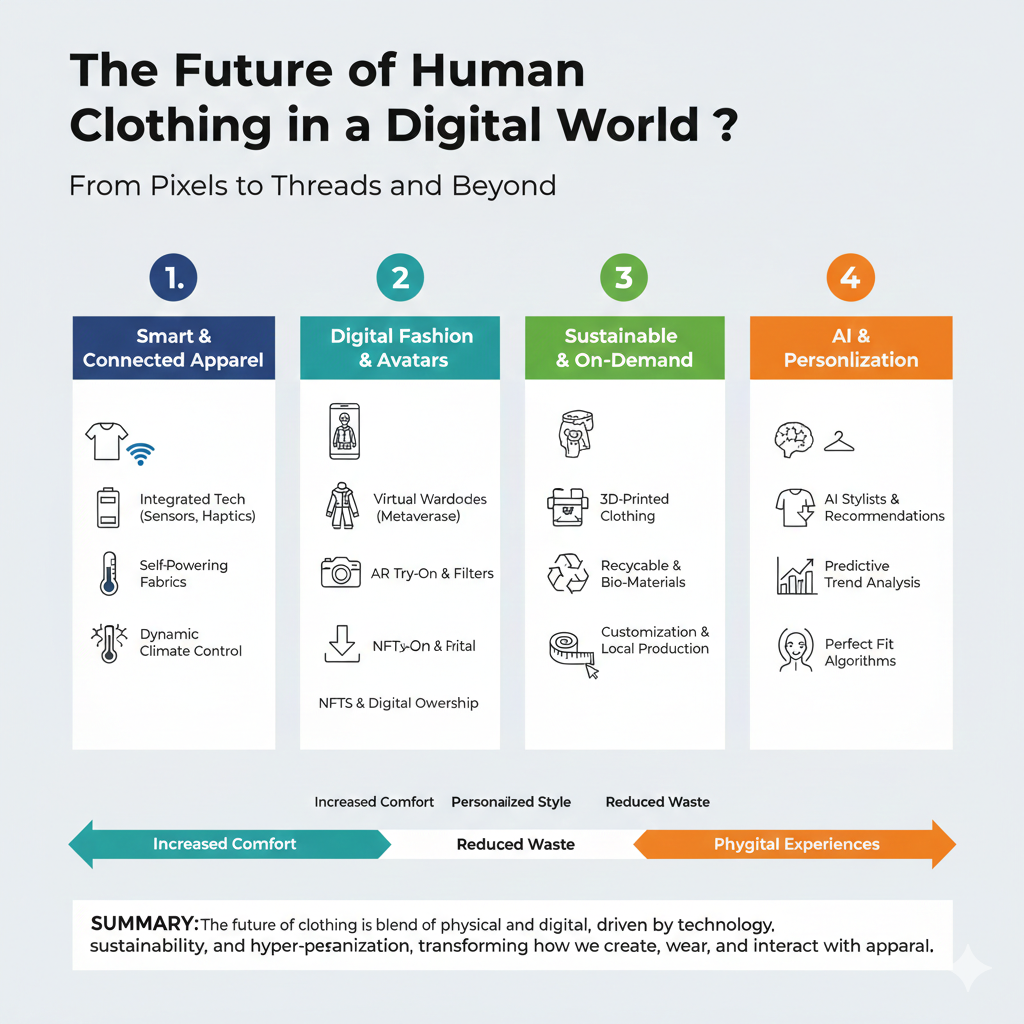
We now curate avatars, buy digital sneakers, and debate whether a hoodie worn in the metaverse counts as real fashion. Smart fabrics respond to our body temperature. Algorithms suggest what we should wear based on mood and weather. Sustainability isn’t a trend anymore—it’s a survival requirement.
The future of human clothing isn’t just about new materials or futuristic aesthetics. It’s about redefining what clothing even means. Will we still need closets? Will gender distinctions fade? And what does it mean to “get dressed” when half of our interactions happen on a screen?
This post explores the next stage of clothing evolution—from smart fabrics and wearable tech to virtual wardrobes and identity-neutral design. If you’ve ever wondered what clothing says about identity or how modern human clothing styles evolution brought us here, this is where that story continues. Welcome to the [future of human clothing hub](Future Hub).
Technology and Smart Fabrics in Future Clothing
Clothing is becoming intelligent. Not in a sci-fi way—though it can feel like that—but in a practical, everyday sense. Garments are starting to sense, adapt, and communicate.
Wearable Technology
Wearable tech is already embedded in our lives. Smartwatches track our steps. Fitness bands monitor our heart rates. But wearable technology in clothing goes further. It turns the fabric itself into a functional interface.
Jackets with built-in heating elements adjust based on external temperature. Shirts embedded with sensors can track posture or breathing patterns and send alerts to your phone. Some athletic gear now measures muscle activity in real time, helping athletes optimize performance without additional devices.
Then there are garments designed for health monitoring. Diabetic socks that detect foot ulcers. Bras that screen for early signs of breast cancer. Baby onesies that monitor breathing and sleep patterns. These aren’t prototypes anymore—they’re available for purchase.
The line between clothing and device is blurring. As batteries get smaller and fabrics more conductive, we may stop thinking of our clothes as passive coverings. They’ll become active participants in how we move through the world.
Adaptive and Responsive Materials
Smart fabrics don’t just house technology—they are the technology. Scientists and designers are creating textiles that react to their environment without needing chips or sensors.
Phase-change materials, for example, absorb or release heat depending on your body temperature. You stay cool when it’s hot, warm when it’s cold—all from the same garment. NASA originally developed this tech for astronauts, but it’s now appearing in everyday jackets and activewear.
Other fabrics change color based on UV exposure, warning you when it’s time to reapply sunscreen. Some textiles are hydrophobic, repelling water so effectively that liquid beads off without leaving a trace. Others are self-cleaning, using nanostructures to break down dirt and bacteria.
Researchers are even experimenting with fabrics that repair themselves. A small tear triggers fibers to reconnect at a molecular level. Imagine never needing to sew a button back on—or throw away a shirt because of one small rip.
Understanding how clothes are made from fiber to fabric gives context to just how radical these innovations are. What once took weeks of manual labor now happens at the molecular level, often autonomously.
Virtual Fashion and Digital Identity
Physical clothing still matters. But increasingly, so does what we wear online. Digital fashion is no longer niche—it’s a growing industry with real economic and cultural weight.
Online Avatars and Virtual Outfits
In virtual spaces like Roblox, Fortnite, Decentraland, and Zepeto, users spend real money on digital clothing. A hoodie for your avatar might cost $5. A limited-edition sneaker drop could go for hundreds. Some luxury brands now release digital-only collections that exist purely in virtual environments.
Why? Because for millions of people, these spaces are where they socialize, work, and express themselves. A teenager might spend more time in a game than at school. A remote worker might attend more meetings as an avatar than in person. In those contexts, clothing and digital identity are inseparable.
NFT fashion has added another layer. Buyers purchase unique digital garments that can be worn across platforms or displayed as collectibles. Some come with physical counterparts. Others exist only in the blockchain. Whether this model lasts or fades, it signals a shift: clothing is no longer confined to the material world.
Social Media Influence on Future Style
Social media has always shaped fashion. But platforms like Instagram, TikTok, and Pinterest don’t just influence trends—they create entire ecosystems of style.
Microtrends emerge and vanish within weeks. A single viral video can make a specific silhouette, color, or accessory ubiquitous overnight. Algorithms curate what we see, subtly shaping our tastes. Influencers become tastemakers with audiences larger than traditional magazines ever had.
This speed and scale change how clothing is designed, produced, and consumed. Brands react faster. Collections shrink in lifespan. The idea of a “timeless wardrobe” feels almost outdated when style cycles move this quickly.
But there’s a counter-movement too. Some users are rejecting hyper-trends in favor of personal style, slower consumption, and garments that last. The future may not be one or the other—it could be both, existing side by side.
Sustainability as the Future of Clothing Design
Fast fashion’s environmental toll is undeniable. The clothing industry is one of the largest polluters globally, contributing to water waste, carbon emissions, and textile landfills. The future of clothing must address this—or there may not be much of a future at all.
Eco-friendly fabrics are gaining ground. Organic cotton, hemp, bamboo, and Tencel offer lower-impact alternatives to conventional materials. Innovations like lab-grown leather and mushroom-based textiles eliminate the need for animal farming or petroleum-based synthetics.
But sustainability isn’t just about materials. It’s about systems. Circular fashion is one answer: designing garments to be repaired, resold, or recycled rather than discarded. Brands are experimenting with take-back programs, where old clothes are returned and remade into new ones. Others are using modular designs, so a single garment can transform into multiple styles.
Transparency is becoming a selling point. Consumers want to know where their clothes come from, who made them, and under what conditions. Blockchain technology is being tested to track garments from raw material to finished product, ensuring ethical sourcing.
The rise of sustainable modern clothing reflects a broader cultural shift. People are questioning whether they need a new outfit every week—or whether a smaller, higher-quality wardrobe makes more sense.
Legislation is catching up too. Some countries are banning the destruction of unsold stock. Others are imposing fees on waste or requiring companies to prove their sustainability claims. The industry is being forced to change, whether it wants to or not.
Will Gendered Fashion Disappear in the Future?
For most of human history, clothing has been divided along gender lines. Men wore one thing, women another. But those boundaries are softening.
Gender-neutral fashion is gaining mainstream acceptance. Designers are creating collections that aren’t marketed as “menswear” or “womenswear”—just clothing. Cuts are becoming more fluid. Colors, once rigidly assigned, are open to anyone.
This isn’t entirely new. Many cultures throughout history dressed people without strict gender divisions. What feels revolutionary now is often a return to older, more flexible norms. But the current movement is also tied to broader conversations about gender identity and expression.
Retailers are responding. Some have eliminated gendered sections in stores. Others are launching unisex lines. Sizes are being reconsidered too, moving away from arbitrary labels toward measurements that fit a wider range of bodies.
The shift isn’t complete, and it won’t happen overnight. But younger generations are leading the charge, and the fashion industry is paying attention. Gender-neutral clothing silhouettes are no longer experimental—they’re practical, wearable, and increasingly common.
From Origins to the Future of Human Clothing
Clothing began as protection. Early humans wrapped themselves in animal skins to survive harsh climates. Over millennia, it became art, identity, rebellion, and status. It marked who we were and who we wanted to be.
Now, we stand at another turning point. Clothing is merging with technology, expanding into virtual spaces, and being reimagined through the lens of sustainability and inclusivity. The garments of tomorrow may not look like what we wear today—and they may not even be physical.
But one thing remains constant: clothing will continue to reflect who we are. Whether we’re dressing an avatar, adjusting a smart jacket’s temperature, or choosing an eco-friendly fabric, we’re still making the same fundamental choice our ancestors did—why humans started wearing clothes in the first place.
Understanding ancient clothing history explained gives us perspective. What feels futuristic now will one day be ancient history too. The future of human clothing isn’t an ending—it’s the next chapter in a story that began thousands of years ago and shows no signs of stopping.