


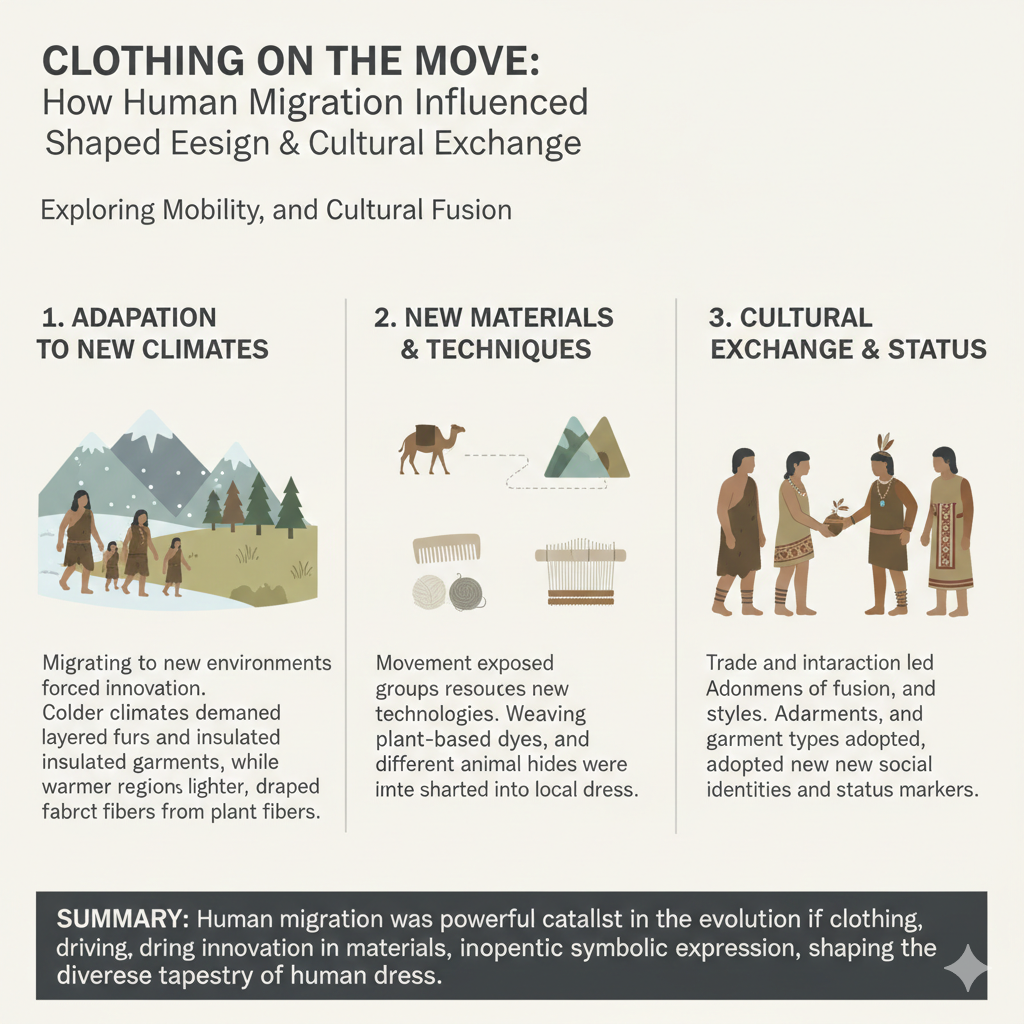
Human beings have always been on the move. From the earliest steps out of Africa to the crossing of land bridges into new continents, migration has been one of the most defining forces in our history. But movement didn’t just change where we lived—it transformed how we lived, and more specifically, what we wore.
Clothing didn’t emerge in a vacuum. It evolved in response to shifting environments, cultural encounters, and the sharing of ideas across vast distances. As early humans migrated into colder climates, they learned to insulate themselves with animal hides. When groups crossed paths along trade routes, they exchanged not only goods but also techniques for weaving, stitching, and adorning garments. Over thousands of years, these interactions shaped regional styles and laid the groundwork for the diverse clothing traditions we see across cultures today.
Understanding why humans started wearing clothes means understanding the role of movement in our species’ survival. Migration forced innovation. It sparked creativity. And it turned clothing from a simple survival tool into a medium of identity, status, and connection. This blog explores how early human migration influenced clothing design, from the materials people chose to the techniques they developed and the cultural meanings they attached to what they wore.
Early Human Migration and Environmental Adaptation
When early humans began to leave Africa and spread across the globe, they encountered environments vastly different from the warm savannas they knew. Some groups migrated north into Europe and Asia, where winters were harsh and freezing temperatures were a constant threat. Others moved into tropical or temperate zones where heat, humidity, and insect activity shaped daily life. Each environment demanded a different approach to clothing.
Cold Regions vs Warm Regions
In colder climates, survival depended on staying warm. Early humans in places like Ice Age Europe needed garments that could trap body heat and protect against wind, snow, and freezing rain. This led to the use of thick, insulated materials like fur and animal skins used in early garments. These weren’t just draped over the body—they were carefully shaped, layered, and sometimes stitched together to create full-coverage outfits that minimized heat loss.
By contrast, groups that migrated into warmer regions faced a different challenge: managing heat while protecting skin from the sun, insects, and rough terrain. Clothing in these areas was often lighter, more breathable, and made from plant-based fibers or thin animal hides. The focus shifted from insulation to ventilation, mobility, and practicality. Understanding clothing in ice age vs tropical regions reveals just how adaptive early humans were in tailoring their garments to their surroundings.
Layering and Material Choices
One of the most important innovations to emerge from migration was layering. In regions with extreme seasonal variation, people learned to add or remove layers depending on the weather. This flexibility allowed them to adapt quickly without needing entirely new garments for each season.
Material choice was equally critical. In areas with abundant animal populations, hides and furs became the first materials used in early clothing. These materials were durable, warm, and relatively easy to work with using basic stone tools. In regions where large game was scarce, people turned to plant fibers, grasses, and bark to create woven or braided garments. This diversity in material use reflects the resourcefulness of early humans and their ability to make the most of their environment.
Cultural Exchange Through Movement and Trade
Migration didn’t just push humans into new climates—it brought them into contact with other groups. When tribes met, they shared knowledge. They traded goods. They observed each other’s clothing and adopted techniques that worked. Over time, these exchanges became a powerful driver of innovation in clothing design.
Early Symbolism and Ornamentation
As humans migrated and formed distinct communities, clothing began to take on symbolic meaning. Garments weren’t just functional—they communicated identity, status, and belonging. Beads, shells, feathers, and colored dyes were used to decorate clothing and signal group affiliation or individual achievements.
These decorative elements spread through migration and trade. A shell bead found hundreds of miles from the nearest coastline suggests that early humans traveled long distances or participated in exchange networks. The sharing of ornamental styles helped create a sense of continuity across regions, even as local environments shaped the practical aspects of clothing. The role of modesty in early clothing also played a part, as certain groups began using garments to cover the body in ways that reflected social norms and spiritual beliefs.
Shared Techniques Across Tribes
Migration facilitated the spread of practical knowledge, too. Techniques for tanning hides, weaving fibers, and attaching garments likely traveled along migration routes. When one group discovered a more efficient way to soften leather or bind seams, that knowledge could be passed on through observation, intermarriage, or trade.
This sharing of techniques helps explain why similar methods appear in geographically distant regions. For example, eyed bone needles—used for sewing—have been found in sites across Europe and Asia, suggesting that the technology spread as people moved. These shared innovations created a foundation for more complex garment construction and eventually led to the development of tailored clothing. For a deeper look at how early humans differed in their approaches, see prehistoric clothing differences.
Migration’s Impact on Sewing Techniques and Construction
Sewing was one of the most transformative innovations in clothing history. Before sewing, garments were often loose-fitting or held together with cords and ties. The invention of the needle allowed for tighter, more fitted clothing that offered better protection and mobility. And migration played a key role in spreading this technology.
As early humans moved into colder climates, the need for fitted, insulated clothing became urgent. Loose wraps wouldn’t keep out the cold. Sewing allowed garments to be shaped to the body, reducing gaps where heat could escape. Bone needles, some dating back over 40,000 years, have been discovered in Siberia and Europe—evidence that sewing emerged in response to environmental pressures brought on by migration.
Once developed, sewing techniques spread quickly. Groups that encountered sewn garments saw their advantages and adopted the practice. Over time, needle designs improved, stitching methods became more refined, and people began experimenting with different seam styles. This evolution didn’t happen in isolation—it was accelerated by movement, trade, and the exchange of ideas. Learn more about the evolution of early sewing tools and how they changed the way humans made clothing.
The journey from fiber to fabric clothing process also highlights how technical knowledge traveled alongside people. Weaving, spinning, and felting techniques likely moved through migration corridors, allowing distant communities to develop similar garment-making methods even without direct contact.
How Migration Led to the Birth of Regional Clothing Styles
As humans settled into different regions and adapted to local conditions, distinct clothing styles began to emerge. These styles were shaped by climate, available materials, cultural values, and the accumulated knowledge passed down through generations. Migration played a foundational role in this diversification.
When groups migrated and then remained relatively isolated, they developed clothing traditions that reflected their unique environments. Arctic peoples perfected insulated outerwear made from caribou and seal skins. Desert communities created loose, breathable garments that shielded them from the sun. Coastal groups incorporated shells, fish leather, and woven grasses into their designs.
But even as regional styles developed, migration continued to influence them. Trade routes connected distant populations, allowing materials, designs, and techniques to flow between regions. A decorative motif from one culture might appear in another hundreds of miles away. A weaving technique developed in one environment might be adapted to suit the materials available elsewhere.
This dynamic between isolation and exchange is what gave rise to the rich diversity of clothing traditions seen in ancient civilizations shaping clothing styles. By the time complex societies emerged, clothing had already undergone thousands of years of innovation driven by human movement and adaptation.
Movement as the Engine of Clothing Evolution
Migration didn’t just change where humans lived—it fundamentally shaped how they dressed. Every time early humans moved into a new environment, they were forced to adapt. They experimented with new materials, developed new construction techniques, and shared their discoveries with others. Over time, these adaptations accumulated, creating a rich tapestry of clothing traditions that reflected the diversity of human experience.
Clothing is more than fabric and thread. It’s a record of human ingenuity, resilience, and connection. The garments we wear today—no matter how modern—are built on tens of thousands of years of innovation sparked by movement. From the first animal hide draped over a shoulder to the tailored garments of early civilizations, every stitch tells a story of migration, adaptation, and cultural exchange.
To explore more about the human clothing evolution journey and how early innovations continue to influence modern fashion, dive deeper into the history of clothing evolution. Understanding where we came from helps us appreciate the creativity and resourcefulness that define what we wear—and who we are.