




Sinner vs. Alcaraz: Is the 2026 Final the Official Changing of the Guard in Men’s Tennis?

For two decades, men’s tennis felt like a closed shop. Roger Federer, Rafael Nadal, and Novak Djokovic—the “Big Three”—hoarded trophies with such regularity that Grand Slam tournaments often felt like coronations rather than contests. Fans wondered when, or if, the next generation would truly arrive. There were false dawns and pretenders to the throne, but the old guard always seemed to find one last reserve of strength.
That narrative has shifted dramatically. As we approach the highly anticipated 2026 final, the conversation is no longer about when the changing of the guard will happen. It is about whether it has already occurred. Jannik Sinner and Carlos Alcaraz have not just knocked on the door; they have kicked it down, renovated the house, and put their names on the deed.
This upcoming match isn’t just another final. It represents the culmination of a rivalry that has breathed new life into the sport. It poses a definitive question: with the legends of the past fading into retirement or slowing down, is the Sinner-Alcaraz duopoly the new undisputed reality of men’s tennis?
The Rise of a New Generation in Men’s Tennis
The transition away from the dominance of Federer, Nadal, and Djokovic was never going to be seamless. For years, the “Next Gen” moniker was applied to players who would occasionally upset a legend but fail to consistently win majors. That pattern broke with the emergence of Carlos Alcaraz and Jannik Sinner.
Unlike their predecessors, who often seemed intimidated by the aura of the Big Three, these two stepped onto the court with a different mindset. They respected the history but refused to be defined by it. The men’s tennis changing of the guard didn’t happen overnight, but the acceleration over the last 24 months has been undeniable.
Recent seasons have seen a near-total lockout of major titles by this young duo. While other players have had moments of brilliance, the Grand Slams have become the exclusive playground of Sinner and Alcaraz. Their consistency on all surfaces—clay, grass, and hard courts—mirrors the versatility that made the Big Three so formidable. We are no longer waiting for the future; the Sinner Alcaraz rivalry is the present.
Sinner vs. Alcaraz — Rivalry Overview
Great rivalries are built on contrast. Borg vs. McEnroe was fire and ice. Federer vs. Nadal was elegance vs. brute force. Sinner vs. Alcaraz offers a modern twist: unstoppable force meets immovable object, played at a pace that seems to defy physics.
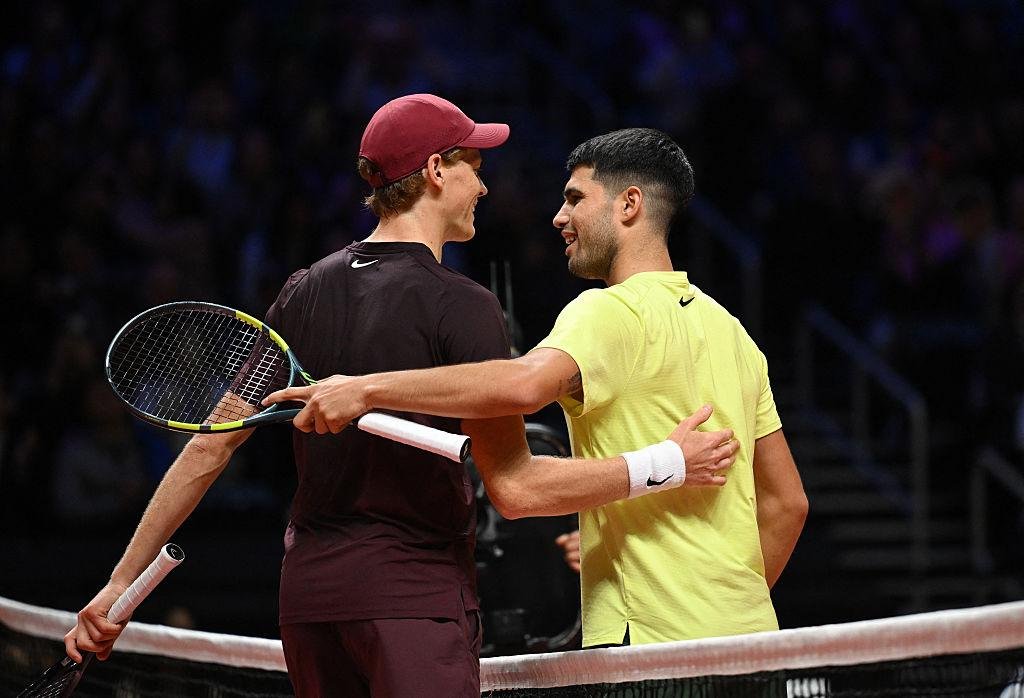
When looking at the Sinner vs Alcaraz record, what stands out is the unpredictability. Neither player has been able to establish total dominance over the other, which is the hallmark of a healthy, long-term rivalry. Their head-to-head major finals and key clashes have produced some of the most electrifying tennis of the decade.
Classic matches that defined the rivalry include their marathon five-setters where momentum swings occurred almost every game. Alcaraz brings explosive athleticism, drop shots that defy belief, and a forehand that can end points from anywhere. Sinner counters with laser-like precision, arguably the cleanest ball-striking on tour, and a backhand that acts as a shield and a sword.
These contrasting styles push each other to evolve. Alcaraz has had to discipline his aggression against Sinner’s defense, while Sinner has had to add variety to his baseline game to disrupt Alcaraz’s rhythm. The Alcaraz Sinner rivalry is compelling because it forces both men to play their absolute best tennis just to survive a set.
Major Wins That Shaped the Narrative
To understand the stakes of the 2026 final, we have to look at the recent history that brought us here. Three specific tournaments serve as the pillars of their current dominance.
First, the 2025 French Open epic final stands as a watershed moment. It was the longest major final in history, a grueling test of endurance that went deep into the fifth set. The quality of shot-making did not dip even after five hours of play. It proved that both men possessed the physical and mental durability to suffer on the biggest stage.
Then came the 2025 US Open final. This was the match where Alcaraz reclaimed the No. 1 ranking, showcasing his ability to bounce back from adversity. It wasn’t just a win; it was a statement that he intended to hold the top spot against his primary rival.
Sandwiched between these hard-court and clay battles was the 2025 Wimbledon victory for Sinner. Winning on grass is often the final piece of the puzzle for a complete player. Sinner’s triumph at the All England Club demonstrated his adaptability and cemented his status as a threat on every surface. When looking at Sinner major wins and Alcaraz Grand Slam history, these victories weren’t just trophies; they were psychological blows exchanged in a battle for supremacy.
Why the 2026 Final Is Special
Context is everything in sports. A final is never just a final when the two best players in the world are involved. The 2026 tennis final preview looks different because the sample size of their dominance is now large enough to draw real conclusions.
Both players have dominated Grand Slam finals recently to such an extent that the betting markets and pundits rarely look outside this duo. In previous years, there was always the looming shadow of Djokovic or a surging Medvedev. Now, the expectation is a Sinner-Alcaraz showdown.
This match feels like a pivot point. If one player wins decisively, they may take a psychological edge that lasts for years. If it is another close classic, it reinforces the idea that we are in for a decade of split titles. The Sinner Alcaraz 2026 Grand Slam final is special because it feels like the “official” start of their prime years. They are no longer prodigies; they are the establishment.
Are We Witnessing a True Changing of the Guard?
Sports media loves to declare a “changing of the guard” every time a young player wins a tournament. But a true tennis era change requires consistency, longevity, and the definitive end of the previous era’s hold on the major trophies.
The comparison to historical transitions is instructive. When Federer began winning, Agassi and Sampras were fading. When Nadal arrived, he challenged Federer directly. The transition from the Fed/Nadal/Djokovic era to now has been slower because the Big Three refused to leave. However, the last two years have provided a clean break.
A strong case can be made that the guard has already changed. It isn’t just about winning; it’s about the feeling of inevitability. When Alcaraz or Sinner walks onto the court, the opponent feels the same sense of doom they used to feel playing Nadal at Roland Garros or Djokovic in Australia. This new tennis generation has established a hierarchy where they sit alone at the top.
What Experts and Players Are Saying
The locker room knows the truth before the fans do. Commentary from peak pros and pundits on the rivalry suggests a widespread acceptance of the new world order.
Former champions have noted the speed of the game. The sheer pace of shot-making in a Sinner-Alcaraz rally is visibly faster than what was played ten years ago. Nick Kyrgios, never one to mince words, recently commented on the future of men’s tennis, suggesting that the athleticism required to beat Sinner or Alcaraz is filtering out the rest of the tour.
Sinner Alcaraz quotes often reflect a mutual respect that borders on reverence. They know they need each other. Experts point out that this tennis generational shift is healthy for the sport. It moves the narrative away from “Who is the GOAT?” to “Who is the best right now?”
The Legacy Question — Who Will Lead the Next Decade?
Forecasting the future in sports is dangerous, but evaluating potential longevity is part of the analysis. Can both co-exist at the top for years? History says yes. Federer and Nadal co-existed. Messi and Ronaldo co-existed.
The Sinner future prospects rely on his clean mechanics. His game is efficient, which typically leads to fewer injuries over a long career. He is the machine—reliable, powerful, and relentless.
The Alcaraz career outlook is slightly different. His game is explosive and physically demanding. He chases down balls that others wouldn’t bother with. The question for Alcaraz is whether his body can sustain that style for 15 years.
Ultimately, the role of physicality, mental strength, and adaptability will decide who leads the next decade. If Alcaraz can protect his body and Sinner can continue to add layers to his game, they will likely trade the number one ranking back and forth until the 2030s.
Frequently Asked Questions (FAQ)
Why is the Sinner vs. Alcaraz rivalry significant?
This rivalry is significant because it represents the first time since the mid-2000s that two young players have simultaneously separated themselves from the rest of the tour. It drives the sport’s evolution, forcing other players to hit the ball harder and move faster just to keep up.
Has Sinner or Alcaraz already surpassed the Big Three?
In terms of legacy and total titles? No. The Big Three accumulated stats over two decades that may never be broken. However, in terms of current level of play and dominance over the current field, Sinner and Alcaraz have surpassed the level the Big Three were playing at the very end of their careers.
Who is favored to win the 2026 final?
Favoritism shifts month to month based on surface and health. Generally, Alcaraz is given a slight edge on clay and slower hard courts due to his variety, while Sinner is often favored on fast hard courts and indoor surfaces where his flat hitting is most effective. The 2026 final is considered a toss-up by most bookmakers.
What does this rivalry mean for tennis fans globally?
For global fans, this rivalry is a gift. It ensures that the excitement of men’s tennis didn’t retire with Federer or Nadal. It drives fan engagement and sport growth by providing a clear narrative: a binary battle for the crown that is easy to understand and thrilling to watch.
How do injuries and coaching changes affect this rivalry?
Injuries are the biggest variable. Both players have had minor setbacks, and how they manage their schedules will determine the longevity of the rivalry. Coaching changes have been minimal so far, as both have stable teams, but any shift in their camps could alter their tactical approaches.
A New Era or Continuation of Greatness?
The 2026 final is more than just a match; it is a coronation of an era that has been threatening to arrive for years. While we will always look back fondly on the golden age of the Big Three, clinging to the past does a disservice to the brilliance unfolding in front of us.
The changing of the guard wasn’t a single moment where a torch was passed; it was a gradual conquest, match by match, title by title. The Sinner–Alcaraz era is reshaping men’s tennis into a faster, more athletic, and equally dramatic spectacle. Whether you are Team Jannik or Team Carlos, one thing is certain: tennis is in safe hands.