




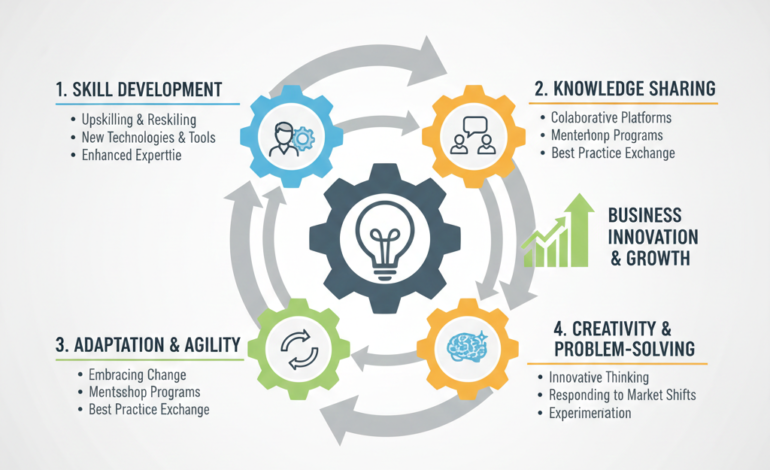

Introduction to Workforce Learning and Innovation
Workforce learning has emerged as a critical component for businesses operating in today’s dynamic and competitive environment. It refers to the continuous process of acquiring new skills, knowledge, and competencies among employees, aimed at enhancing their effectiveness in their roles. With the rapid evolution of technology and market demands, organizations must foster a culture of learning that adapts to these changes swiftly. This ongoing education not only empowers employees but also equips them to tackle complex challenges and contribute meaningfully to the organization’s goals.
Innovation, on the other hand, can be defined as the process of translating new ideas into tangible solutions, products, or services that add value to an organization. It serves as the lifeblood of any business striving to maintain a competitive edge. The need for innovation is constant, fueled by changing consumer preferences, advances in technology, and the desire for improved efficiencies. Thus, the interplay between workforce learning and innovation is significant; as employees engage in learning, they inherently become more creative and proficient at identifying and implementing innovative solutions.
The interconnectedness of these two concepts cannot be overstated. As employees engage in workforce learning, they develop critical thinking and problem-solving skills that enhance their ability to innovate. In environments where learning is prioritized, employees feel more confident to experiment, take calculated risks, and share ideas without fear of failure. This not only accelerates the innovation process but also fosters a culture that embraces change and encourages continual improvement.
In essence, workforce learning is foundational to the innovation ecosystem within an organization. By understanding and implementing effective learning strategies, businesses can cultivate an adaptive workforce that not only keeps pace with change but also drives innovation forward.
The Role of Continuous Learning in Fostering Innovation
In today’s fast-paced business environment, continuous learning plays a vital role in fostering innovation within organizations. Companies that prioritize ongoing education create a culture where employees are encouraged to think creatively and explore new ideas. This not only enhances individual skill sets but also contributes significantly to the organizational knowledge base, enabling teams to devise innovative solutions to complex challenges.
A key component of effective continuous learning programs is their ability to promote creative thinking. These initiatives often include workshops, seminars, and online courses that focus on developing critical problem-solving skills. For instance, companies like Google and Facebook have implemented programs that provide employees with opportunities to experiment with new concepts and technologies, fostering an environment that nurtures innovation. By enabling employees to engage in continuous learning, organizations can stimulate an atmosphere where innovative ideas flourish.
Statistics indicate that organizations with robust learning and development programs experience higher innovation outcomes. A study by the American Society for Training and Development (ASTD) found that organizations that invest in employee training see a 24% higher profit margin than those that do not. This highlights the direct correlation between continuous learning and innovative performance. Furthermore, companies that encourage knowledge sharing and collaboration among teams often witness an increase in both the quantity and quality of innovative ideas generated within their workforce.
Moreover, continuous learning initiatives can also enhance an organization’s adaptability to change, which is crucial for innovation. In a world where technology and market dynamics evolve rapidly, organizations equipped with a continuous learning framework are better prepared to pivot in response to new trends. This agility enables teams to remain competitive and innovative, driving the organization towards sustained success.
Building Diverse Skill Sets to Drive Creativity
In today’s fast-paced business environment, fostering innovation is crucial for organizations aiming to stay competitive. One effective strategy for cultivating a culture of creativity is to equip employees with diverse skill sets through targeted training programs. When employees possess a variety of competencies, they are better prepared to tackle complex challenges and identify unique solutions that might not be apparent to those with a narrower focus.
For example, consider how a company like Google has implemented a range of learning initiatives that encourage its workforce to explore different fields, from data analytics to creative design. This approach not only broadens the expertise of their employees, but it also instills an ethos of continuous learning and adaptability. Employees whose skills range across disciplines are often more confident in their ability to innovate and contribute to project outcomes, thereby enhancing the company’s overall performance.
Moreover, research indicates that organizations that prioritize diverse skill development experience greater agility when responding to market changes. For instance, IBM has successfully integrated cross-training and upskilling within its workforce, resulting in employees who can pivot and apply their knowledge to new areas as challenges arise. This proactive approach allows businesses to leverage their employees’ varied skills to adapt to evolving consumer needs and technological advancements.
Case studies from companies such as Amazon also demonstrate the positive impact of investing in a diverse skill set. By fostering a culture of innovation through training programs, these companies have not only driven creativity but also improved employee satisfaction and retention rates. When employees see investment in their professional development, they are more likely to be engaged and contribute actively to the organization’s innovative efforts.
Creating an Innovative Mindset through Learning
In today’s competitive landscape, fostering an innovative mindset among employees is essential for organizations seeking sustainable growth and success. Workforce learning plays a critical role in shaping this mindset, as it encourages employees to adopt a culture of curiosity and experimentation. By providing opportunities for continuous development, organizations can stimulate creativity and empower employees to explore new ideas.
One effective method for cultivating innovation is the implementation of workshops designed specifically for skill enhancement and creative problem-solving. These workshops can incorporate hands-on activities that allow participants to brainstorm ideas and collaborate in teams. Engaging in such interactive settings not only nurtures a sense of teamwork but also introduces employees to diverse perspectives, thereby fostering a more innovative approach to their work.
Another approach to promote an innovative mindset is through hackathons. These time-bound events encourage employees to work on projects that go beyond their everyday tasks, often focusing on solving specific challenges the company faces. Hackathons provide a risk-tolerant environment where employees feel safe to experiment with unconventional solutions. The competitive aspect of hackathons motivates participants to push the boundaries of their creativity and implement out-of-the-box thinking.
Moreover, leveraging technology in learning initiatives, such as e-learning platforms and online courses, allows employees to access resources that broaden their knowledge and skills. These platforms can offer tailored courses that focus on innovative techniques and best practices, thus aligning personal growth with organizational objectives.
By creating spaces and opportunities for workforce learning, organizations can significantly enhance their employees’ innovative mindset. Encouraging continuous education, interactivity, and collaboration ensures that employees are not only prepared to tackle current challenges but also inspired to lead the way in future innovation efforts.
Collaboration and Knowledge Sharing as Catalysts for Innovation
In today’s fast-paced and ever-evolving business landscape, fostering collaboration and knowledge sharing within the workforce has become essential for driving innovation. Organizations that promote a culture of collective learning not only enhance employee engagement but also unlock new avenues for creative problem-solving. As a result, collaborative learning emerges as a critical component in fostering innovative practices.
To facilitate this collaborative environment, many organizations have adopted various platforms and technologies. Tools such as collaborative software, intranet frameworks, and cloud-based systems provide employees with the opportunity to share insights and exchange ideas across departments. For instance, companies like Google leverage their Google Workspace to allow teams to collaborate seamlessly on projects, ensuring that knowledge flows freely and effectively. Such tools serve not only as repositories for information but also as environments where innovation can flourish through dynamic discussions and brainstorming sessions.
Moreover, real-world examples further illustrate the significant impact of knowledge sharing on innovation. For instance, IBM has established numerous communities of practice where employees can connect with experts in their respective fields. These initiatives encourage skill development and create rich spaces for discourse, ultimately leading to innovative solutions and processes. Likewise, Siemens utilizes digital platforms to promote cross-functional collaboration, enabling teams to learn from one another and push creative boundaries.
In addition, mentorship programs are another avenue through which organizations can enhance knowledge sharing. Pairing seasoned professionals with newcomers facilitates a learning culture where skills, experiences, and innovative ideas are exchanged. This not only accelerates the professional development of individuals but also strengthens the overall capabilities of the organization.
Thus, by actively promoting collaboration and establishing robust channels for knowledge sharing, organizations can create an environment that not only nurtures innovation but also prepares them for future challenges in their respective industries.
Real-world Examples: Companies Leading the Charge
Numerous organizations today are proactively integrating workforce learning strategies into their innovation processes, achieving impressive outcomes. One noteworthy example is Google, which employs a culture of continuous learning to encourage employees to develop their skills through various learning opportunities, including workshops and online courses. This focus enables teams to experiment and embrace innovative practices, as seen with the development of Google Assistant—a product that capitalizes on cutting-edge technology thanks to the workforce’s grassroots learning initiatives.
Another significant case is IBM, which leverages its vibrant learning ecosystem to foster innovation across its diverse teams. By implementing programs such as IBM’s “Skills Academy,” the company empowers employees to enhance their expertise in areas like artificial intelligence and data science. This commitment to workforce learning not only equips employees with essential skills but also fuels the development of groundbreaking services, exemplified by their Watson AI projects, which push the boundaries of what is possible in technology.
Furthermore, Unilever has made remarkable strides by prioritizing workforce learning in its innovation framework. Recognizing the importance of agility in consumer goods, Unilever fosters a culture that encourages ongoing education through initiatives like “Unilever Future Leaders Programme.” This strategic approach enables employees to gain insights into market trends and consumer behavior, driving innovative product development and marketing strategies. The company’s recent launch of sustainable products showcases how investing in learning can yield significant returns in terms of market relevance.
These cases illustrate that companies actively leading in innovation are those that recognize the value of workforce learning. By facilitating skill development, organizations can cultivate the creative potential of their workforce, thereby achieving transformative results in their products and services. Such initiatives also highlight the critical role of learning as a cornerstone for sustained innovation.
Challenges in Implementing Workforce Learning for Innovation
Implementing workforce learning programs aimed at promoting innovation can present several significant challenges for organizations. These challenges can hinder the effectiveness of training strategies and ultimately impact the organization’s ability to innovate effectively. Understanding these obstacles is critical for developing effective solutions.
One of the foremost challenges faced is resistance to change. Employees may be accustomed to traditional ways of working and can demonstrate a reluctance to embrace new learning initiatives. This resistance can stem from fear of the unknown, concerns about their capabilities to acquire new skills, or a lack of understanding regarding the benefits of workforce learning programs. To address this issue, organizations should emphasize the advantages of continuous professional development and demonstrate how such programs enhance personal and organizational growth.
Another common obstacle faced by organizations is budget constraints. Allocating sufficient funds for workforce learning can be challenging, particularly in an economic climate where resources may be tightly controlled. Training programs often require upfront investment in terms of both time and money. Organizations must weigh these costs against the long-term benefits of innovative capabilities that a skilled workforce can bring. Developing a clear business case that outlines the return on investment for such programs can be vital in securing necessary funding.
Finally, measuring the success of workforce learning initiatives poses its own challenges. Quantifying innovation directly linked to training can be complicated. Organizations often struggle to find appropriate metrics that reflect both short-term and long-term outcomes. In this regard, implementing a robust evaluation framework that considers both quantitative and qualitative measures can be beneficial, allowing organizations to assess the effectiveness of their workforce learning initiatives systematically.
Future Trends in Workforce Learning and Innovation
The landscape of workforce learning is rapidly evolving, with new trends poised to enhance innovation within organizations. One of the most significant trends is the increasing adoption of AI-driven learning platforms. These platforms leverage algorithms to customize learning experiences, ensuring employees receive tailored content that enhances their skills relevant to their roles. AI’s ability to analyze performance data allows organizations to identify skill gaps and deliver targeted training, fostering a culture of continuous innovation.
Another trend gaining traction is the use of virtual reality (VR) training. VR technology offers immersive learning experiences, enabling employees to engage in realistic simulations. This method of workforce training not only enhances knowledge retention but also encourages innovative thinking by providing employees with a safe environment to experiment and solve problems. As organizations invest in VR training modules, they equip their workforce with the skills needed to navigate complex scenarios and adapt to changing market demands.
Personalized learning paths are also becoming increasingly prevalent within the realm of workforce education. By embracing a data-driven approach, organizations are enabling employees to progress through learning modules that align with their individual career aspirations. This customization not only motivates employees but also fuels innovation, as they can develop specialized expertise that directly contributes to their organization’s goals. The alignment of individualized learning with organizational objectives creates an agile workforce capable of responding to new challenges effectively.
As we look towards the future, these trends signal a transformative shift in how workforce learning occurs. By harnessing the power of technology such as AI, VR, and optimized learning paths, organizations can cultivate a more innovative workforce equipped to thrive in an ever-evolving business landscape. The synergy between advanced learning methodologies and innovation will undoubtedly play a crucial role in shaping successful organizations.
Conclusion: The Path Forward for Organizations
As organizations navigate the complexities of the modern business landscape, prioritizing workforce learning emerges as a vital strategy for fostering continuous innovation. Embedding a culture that values learning not only enhances employee skills and knowledge but also accelerates organizational adaptability in response to evolving market demands. The integration of workforce learning into daily operations ensures that employees remain engaged and better equipped to contribute innovative ideas.
To create an environment conducive to both learning and innovation, organizational leaders should focus on several actionable steps. Firstly, investing in tailored training programs that align with both current and future organizational needs can empower employees to expand their expertise. This includes utilizing diverse learning formats such as workshops, e-learning modules, and mentorship initiatives that cater to various learning styles.
Secondly, fostering open communication and collaboration can further enhance workforce learning. Creating platforms for employees to share knowledge, discuss challenges, and develop solutions collectively promotes a culture of continuous improvement. Encouraging cross-departmental projects can also stimulate fresh perspectives and innovative approaches to problem-solving.
Moreover, it is essential for leaders to model a commitment to lifelong learning themselves. When organizational leaders visibly engage in their own learning journeys, they set a powerful example that resonates throughout the workforce. Acknowledging and rewarding innovation resultant from learning efforts can also motivate employees to take ownership of their personal and professional development.
Ultimately, sustaining an innovative edge in today’s fast-paced business environment hinges on a commitment to workforce learning. By embedding this practice within the organizational culture, companies can foster resilience, adaptability, and sustained growth, positioning themselves as leaders in their respective industries.