


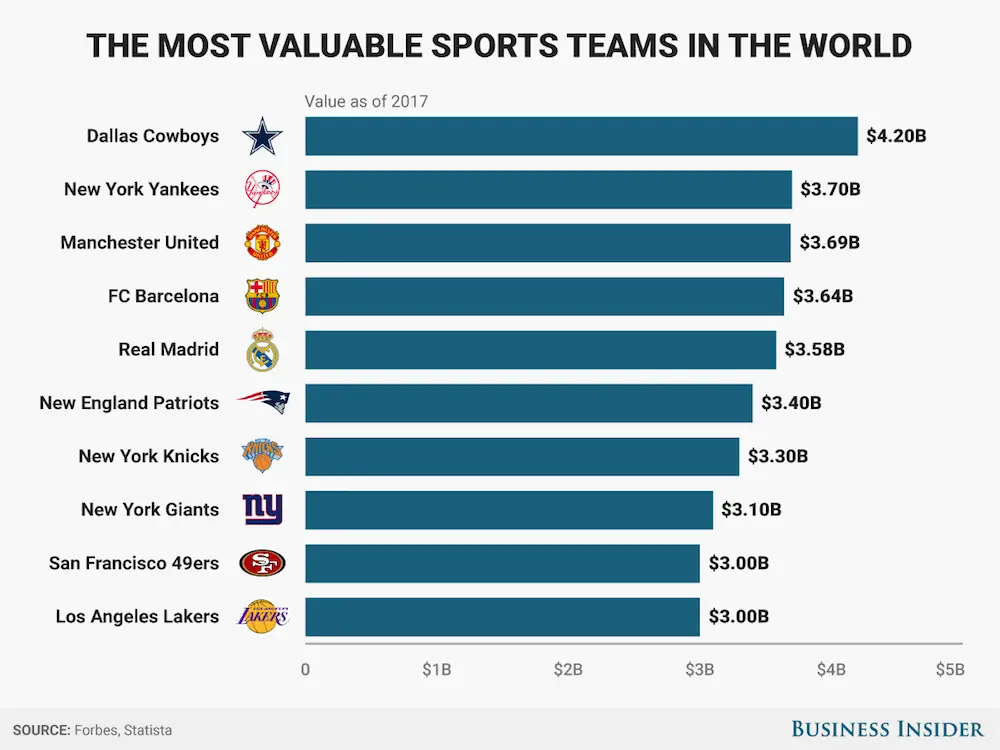
For decades, owning a sports team was viewed as a vanity project for the ultra-wealthy—a fun way to burn cash while sitting courtside. Those days are long gone. Today, professional sports teams are sophisticated, multi-billion-dollar media conglomerates. They are asset classes that consistently outperform the S&P 500, resilient to recessions and fueled by an insatiable global appetite for live entertainment.
When we look at the financial landscape of global athletics, one trend becomes immediately clear: American teams dominate. From gridiron giants to hardwood icons, the USA is home to the vast majority of the financial heavyweights in the industry. While European football boasts the most fans globally, the sophisticated business models of American leagues have created valuations that seem to defy gravity.
This shift from “pastime” to “powerhouse” is driven by exploding media rights, modernized stadiums that act as year-round entertainment hubs, and savvy branding that transcends borders. Understanding who sits at the top of this financial food chain—and why—offers a fascinating glimpse into the intersection of culture and capitalism.
How Sports Franchise Value Is Calculated
Determining the worth of a team is more art than science, but financial experts generally rely on specific metrics to arrive at a “sports franchise valuation.” It isn’t just about how much cash a team has in the bank; it is about the potential for future earnings and the scarcity of the asset.
The primary driver is revenue multiples. Analysts look at the revenue a team generates from ticket sales, broadcasting rights, and merchandise, then apply a multiplier based on the league’s health and market size. For example, an NFL team might trade at a higher multiple of revenue than a retailer because NFL teams are rare assets that almost never lose value.
Brand equity plays a massive role as well. The Dallas Cowboys or the New York Yankees possess brand recognition that holds value regardless of their win-loss record in a specific season. This “brand tax” allows them to command higher sponsorship deals than smaller market competitors.
Finally, tangible assets matter. Modern valuations increasingly include stadium ownership and surrounding real estate developments. Teams that own their venues—and the shopping districts built around them—control their own destiny, capturing revenue from concerts, retail, and parking long after the season ends.
Most Valuable Sports Franchises in the World USA
When Forbes or Sportico release their annual rankings, the list is overwhelmingly American. In recent years, it is common to see over 40 of the top 50 most valuable teams hailing from the United States. This concentration of wealth is unique to the North American sports landscape.
The dominance of the “most valuable sports franchises in the world USA” is not accidental. It is the result of structured league economics designed to ensure profitability. While a top-tier European soccer club might generate massive revenue, they also face the financial threat of relegation and uncapped spending wars for players. American franchises operate in closed ecosystems where revenue is shared, and costs are often controlled via salary caps.
This stability attracts investors. Knowing that a team cannot “drop out” of the league reduces risk significantly. Consequently, American franchises in the NFL, NBA, and MLB have seen their values skyrocket over the last decade, outpacing their international counterparts by a significant margin.
NFL Teams Dominating Franchise Valuations
If there is a king of the sports financial jungle, it is the National Football League. The NFL is a financial juggernaut that arguably serves as the most powerful media property in the United States. In almost every ranking of the most valuable NFL teams, you will find the Dallas Cowboys at the very top—often ranking as the most valuable sports team on the planet.
The NFL’s dominance is built on the back of massive media rights deals. The league’s long-term contracts with networks like CBS, NBC, Fox, ESPN, and Amazon are worth over $110 billion. This money is shared equally among all 32 teams. Before a single ticket is sold, every NFL owner is guaranteed hundreds of millions of dollars in national revenue.
Furthermore, the NFL’s “hard salary cap” ensures cost certainty. Owners know exactly what their maximum player payroll will be, protecting their profit margins. Combined with a scarce schedule (only 17 regular-season games) that turns every matchup into a must-watch event, the NFL model is the gold standard for sports profitability.
NBA Franchises With Global Appeal
While the NFL dominates domestically, the National Basketball Association (NBA) is the master of global export. The most valuable NBA teams—led by the Golden State Warriors, New York Knicks, and Los Angeles Lakers—leverage star power to drive value across oceans.
The NBA is a star-driven league. An individual player like LeBron James or Stephen Curry has a social media following that dwarfs entire NFL rosters. This allows NBA franchises to market themselves in China, Europe, and Africa more effectively than other American leagues. The digital footprint of the NBA is massive, appealing to a younger, tech-savvy demographic that consumes highlights on phones rather than full games on cable.
This global reach translates to dollars. The NBA’s upcoming media rights negotiations are expected to double or triple current values, potentially pushing average team valuations closer to NFL levels. For investors, the NBA represents growth; it is the league best positioned to capitalize on the digitization of sports media.
MLB & Legacy Sports Franchises
Baseball may be America’s pastime, but it is also a lesson in regional economic power. The most valuable MLB teams, such as the New York Yankees and the Los Angeles Dodgers, are built on history and massive local media markets.
Unlike the NFL, which relies heavily on national TV deals, MLB teams rely significantly on Regional Sports Networks (RSNs). Because baseball teams play 162 games a year, they provide massive inventory for local cable channels. This allows top-tier teams to sign lucrative local broadcasting contracts worth billions over the life of the deal.
However, the gap between the rich and the poor in baseball is wider than in the NFL. The Yankees can generate revenue that small-market teams simply cannot match. Yet, the stability of MLB—which has enjoyed labor peace and consistent attendance numbers—makes these franchises “blue chip” stocks. They are legacy assets that offer consistent, reliable returns over decades.
Global Non-USA Franchises Worth Billions
While the USA dominates the volume of high-value teams, the rest of the world still boasts iconic brands that rival the American giants. When discussing the most valuable sports teams worldwide, names like Real Madrid, FC Barcelona, and Manchester United are always in the conversation.
These European football clubs command fanbases that number in the hundreds of millions. Their social media reach far exceeds that of NFL teams. However, their valuations are often suppressed by the volatility of European football economics—specifically the lack of salary caps and the risk of missing out on lucrative Champions League play.
Formula One is another sector seeing rapid growth. Teams like Ferrari and Mercedes have seen their valuations spike thanks to cost caps introduced by the FIA and the exploding popularity of the sport in the US (driven largely by Netflix’s Drive to Survive). F1 teams are becoming more like American franchises: profitable, scarce, and increasingly valuable.
Revenue Streams Powering Franchise Growth
How do these teams actually make money? The days of relying solely on gate receipts are over. To understand sports team revenue streams today, you have to look at the diversified portfolio of a modern franchise.
- Broadcasting Rights: This is the engine of the industry. National and local TV deals provide the guaranteed cash flow that underpins billion-dollar valuations.
- Sponsorships: From jersey patches to “official partner” designations, corporate money is everywhere.
- Stadiums and Real Estate: Teams are no longer just tenants; they are landlords. Developing the land around a stadium into hotels, apartments, and retail centers turns a game-day business into a 365-day revenue stream.
- Merchandising: Licensing logos for apparel, video games, and collectibles provides high-margin royalty income.
Role of Media, Streaming & Technology
The skyrocketing “sports media rights value” is the single biggest factor in the explosion of franchise prices. Live sports remains the only content that can reliably aggregate massive, real-time audiences, making it invaluable to advertisers and cable carriers.
However, the landscape is shifting. Tech giants like Amazon, Apple, and Google (YouTube) are entering the arena, bidding up the price of broadcasting rights. Apple’s deal with Major League Soccer and Amazon’s Thursday Night Football package are just the beginning.
As traditional cable bundles decline, franchises are pivoting to direct-to-consumer streaming apps and fan engagement platforms. Technology is also opening new revenue lines through digital collectibles and specialized “second screen” experiences where fans can bet or buy merch instantly while watching the game.
Why USA Sports Franchises Lead Globally
The question often arises: why US sports teams are so valuable compared to their global counterparts? The answer lies in the business structure. American sports operate as closed leagues. There is no promotion or relegation. If the Jacksonville Jaguars have a terrible season, they are not kicked out of the NFL; in fact, they get a better draft pick to help them improve.
This socialism-for-the-rich model eliminates the catastrophic financial risk found in European soccer. It encourages parity, meaning more teams are competitive, which keeps fan interest high across more markets. Furthermore, the US domestic market is wealthy and vast, allowing teams to generate immense revenue without needing to look internationally.
Future Trends in Sports Franchise Valuations
Looking ahead, the future of sports franchises appears poised for further growth, though the drivers of that growth may change. One major trend is the influx of institutional capital. Leagues that previously prohibited private equity firms from owning stakes in teams are beginning to loosen those rules. This opens up a massive new pool of liquidity, driving prices even higher.
We are also seeing a shift toward multi-club ownership models, where a single group owns teams across different sports and continents to maximize efficiencies. Additionally, the rise of women’s sports is creating a new asset class with tremendous upside potential, as seen in the growing valuations of NWSL and WNBA teams.
Finally, the integration of physical sports with esports and digital worlds offers a new frontier. Engaging the next generation of fans who may prefer video games to live broadcast will be crucial for sustaining value in the decades to come.
Frequently Asked Questions (FAQ)
Q1. What is the most valuable sports franchise in the world?
While rankings fluctuate annually based on stock markets and new media deals, the Dallas Cowboys (NFL) consistently hold the top spot, often valued significantly higher than any other team globally.
Q2. Why are USA sports franchises so valuable?
They operate in “closed” leagues with no relegation risk, share lucrative media revenue equally, and benefit from cost controls like salary caps. This ensures consistent profitability and safety for investors.
Q3. Which league has the most billion-dollar teams?
The NFL. Every single team in the NFL is worth multi-billions, largely due to their massive national television contracts and revenue-sharing model.
Q4. How do sports teams make most of their money?
For top-tier leagues, media and broadcasting rights are the largest source of revenue, followed by commercial sponsorships and stadium-related income (tickets, luxury suites, concessions).
Q5. Are European football clubs catching up in value?
Top clubs like Real Madrid and Manchester United are growing, but the structural advantages of US leagues (salary caps and no relegation) mean American teams are generally growing at a faster rate and hold higher average valuations.
Q6. Do winning teams always have higher valuations?
Not necessarily. The New York Knicks (NBA) have struggled competitively for decades but remain one of the most valuable teams due to the massive New York market and the iconic status of Madison Square Garden.
Q7. Will sports franchise values keep rising after 2026?
Most analysts predict yes. The entry of Big Tech (Apple, Amazon) into sports broadcasting and the loosening of ownership rules to allow private equity are expected to drive valuations higher.
Final Thoughts: Sports Franchises as Global Power Brands
The numbers associated with modern sports franchises can feel abstract, but they represent a fundamental truth about the entertainment economy. These are no longer just teams; they are global power brands.
Valuations reflect more than just wins and losses. They reflect the ability of a logo to command attention in a fragmented media world. They reflect the safety of an asset class that people care about passionately, regardless of the economy. As technology continues to evolve and the world becomes more interconnected, the most valuable sports franchises in the world USA will likely continue to set the pace, transforming the simple joy of a game into serious, high-stakes business.