


Money sitting in a standard checking account is losing value. It might look safe, but thanks to inflation, the purchasing power of that cash slowly erodes every year. If a loaf of bread costs $3.00 today and $3.15 next year, your uninvested dollar buys less bread. This is why investing is essential.
Investing is the process of putting your money to work so it grows over time. It is the most reliable way to build wealth, beat inflation, and achieve financial freedom. While saving is important for emergencies and short-term purchases, investing is the engine that powers long-term goals like buying a home, funding a college education, or retiring comfortably.
For many living in the USA, the financial markets can seem intimidating. Terms like “bear market,” “dividends,” and “asset allocation” often sound like a foreign language. However, the basic concepts are straightforward once you strip away the jargon. This guide will walk you through the investment landscape in the USA, breaking down the options available to beginners so you can start building your financial future with confidence.
What Is Investing?
At its core, investing basics in the USA revolve around a simple concept: you provide capital (money) to a business, government, or project in exchange for a potential profit. Unlike saving, where your principal is generally guaranteed (up to FDIC limits), investing involves risk. The value of your investments can go up, but they can also go down.
How investing works
When you invest, you are buying an asset that you believe will increase in value or generate income. This creates a compound effect. Your initial investment earns a return, and then that return earns its own return. Over decades, this compounding can turn modest monthly contributions into substantial wealth.
Risk vs. reward explained
There is a direct relationship between risk and reward. Generally, the safer the investment, the lower the return. A government bond is very safe but offers low interest. A stock in a new technology startup is risky but could skyrocket in value. Successful investing is about finding a balance that lets you sleep at night while still reaching your goals.
Short-term vs. long-term investing
Your time horizon—how long you plan to hold an investment—dictates your strategy. Short-term investing (less than 3 years) usually requires safer assets because you don’t have time to recover if the market crashes. Long-term investing (10+ years) allows you to take more risks because you can ride out the market’s natural ups and downs.
Common Investment Options Explained
The American financial system offers a massive menu of assets. Understanding these investment options for beginners in the USA is the first step toward building a portfolio.
Stocks
When people talk about stock market investing in the USA, they are talking about buying equity. When you buy a stock, you become a partial owner of that corporation.
- Ownership in companies: If you buy a share of Apple, you own a tiny fraction of Apple. As the company grows and becomes more profitable, the value of your share typically increases.
- Potential returns and risks: Stocks have historically offered high returns compared to other asset classes, averaging about 10% annually over the last century (before inflation). However, they are volatile. Prices change daily, and companies can go bankrupt.
- Dividends and growth stocks: Some companies pay you a portion of their profits regularly; these are called dividends. Growth stocks, conversely, reinvest their profits to expand, hoping to increase the share price rapidly.
Bonds
Bonds investment in the USA is essentially lending money. You loan money to a government or a corporation for a set period. In return, they pay you interest (the coupon) and return your original money (the principal) when the bond matures.
- Fixed-income investing: Bonds are often called “fixed income” because you know exactly how much you will get paid and when.
- Government vs. corporate bonds: US Treasury bonds are considered virtually risk-free because they are backed by the US government. Corporate bonds are riskier because a company could default on its debt, but they pay higher interest rates to compensate for that risk.
- Stability and income generation: Investors add bonds to their portfolios to reduce volatility. When the stock market crashes, bonds often remain stable or even increase in value.
Mutual Funds
For mutual funds for beginners in the USA, think of a potluck dinner. Instead of buying individual ingredients (stocks), everyone chips in money to hire a chef (fund manager) to cook a meal for everyone.
- Professionally managed portfolios: A mutual fund pools money from thousands of investors to buy a diversified mix of stocks, bonds, or other assets. A professional manager makes the buying and selling decisions.
- Diversification benefits: By owning one share of a mutual fund, you might instantly own small pieces of 500 different companies. This spreads out your risk.
- Expense ratios explained: Convenience comes at a cost. Mutual funds charge an annual fee, known as an expense ratio. It is crucial to watch these fees, as a high expense ratio (over 1%) can eat into your profits significantly over time.
Exchange-Traded Funds (ETFs)
ETFs investing in the USA has exploded in popularity. ETFs are similar to mutual funds in that they offer a basket of assets, but they trade on the stock exchange like a single stock.
- How ETFs work: You can buy and sell ETFs throughout the trading day. They are generally more tax-efficient and have lower fees than traditional mutual funds.
- Index ETFs vs. sector ETFs: Many beginners start with “Index ETFs” that track the entire market, like the S&P 500. Others choose “Sector ETFs” that focus on specific industries, like energy or technology.
- Why beginners like ETFs: They offer instant diversification with very low fees (often 0.03% to 0.10%), making them one of the most cost-effective ways to build wealth.
Real Estate
Real estate investing in the USA involves purchasing property to generate rental income or to resell for a profit.
- Rental properties: This involves buying a house or apartment and renting it out. While lucrative, being a landlord requires significant capital and effort.
- REITs for beginners: Real Estate Investment Trusts (REITs) allow you to invest in real estate without fixing toilets. REITs are companies that own commercial real estate (like malls, hospitals, or apartments). You buy shares of a REIT on the stock market just like a regular stock, and they pay out dividends from the rental income.
- Long-term value appreciation: Real estate generally appreciates over time and acts as a good hedge against inflation.
Retirement Accounts
It is important to clarify that retirement accounts are not investments themselves; they are tax-advantaged accounts that hold your investments. Retirement investing in the USA centers on these vehicles:
- 401(k): Offered by employers. You contribute pre-tax money from your paycheck. Many companies offer “employer matching,” where they match your contribution up to a certain percentage. This is essentially free money and should be your first priority.
- IRA (Individual Retirement Account): An account you open yourself. Traditional IRAs offer tax breaks now (tax-deferred), while Roth IRAs offer tax breaks later (tax-free withdrawals in retirement).
- Tax advantages: The government wants you to save for retirement, so these accounts offer significant tax breaks that regular brokerage accounts do not.
How to Choose the Right Investment Option
With so many choices, knowing how to choose investments in the USA depends on your personal situation.
- Risk tolerance: Can you handle watching your account balance drop 20% in a week without panic-selling? If yes, you might lean toward stocks. If no, you might want more bonds.
- Time horizon: If you are saving for a house down payment needed in two years, the stock market is too risky. Stick to high-yield savings or bonds. If you are saving for retirement 30 years away, you need the growth potential of stocks.
- Financial goals: Define what the money is for. Growth? Income? Preservation? Your goal dictates the vehicle.
Diversification: Reducing Risk
You have likely heard the phrase, “don’t put all your eggs in one basket.” This is the definition of a diversified investment portfolio in the USA.
Why diversification matters
If you invest all your money in one company and that company goes bankrupt, you lose everything. If you invest in an S&P 500 fund, you own 500 companies. If one goes bankrupt, it barely impacts your portfolio.
Asset allocation basics
Diversification also means holding different types of assets. A common rule of thumb is the 60/40 split: 60% of your money in stocks (for growth) and 40% in bonds (for stability). Younger investors often hold more stocks (e.g., 90/10) because they have time to recover from market drops.
Avoiding common beginner mistakes
Don’t just buy five different technology stocks and call it diversified. True diversification means owning investments that behave differently—when one goes down, the other might go up.
How Much Money Do You Need to Start Investing?
A common myth is that you need to be rich to start. You can actually start investing with little money in the USA.
- Low-cost investing platforms: Apps like Fidelity, Schwab, and Robinhood have eliminated trading commissions. You can buy and sell stocks for $0.
- Fractional shares: You used to need $3,000 to buy one share of Amazon. Now, many brokerages allow you to buy “fractional shares.” If you have $50, you can buy $50 worth of Amazon.
- Automatic investing tools: “Robo-advisors” like Betterment or Wealthfront can build a diversified portfolio for you automatically. You just set up a recurring transfer of $50 or $100 a month.
Common Investing Mistakes Beginners Should Avoid
Understanding investing mistakes beginners make can save you thousands of dollars.
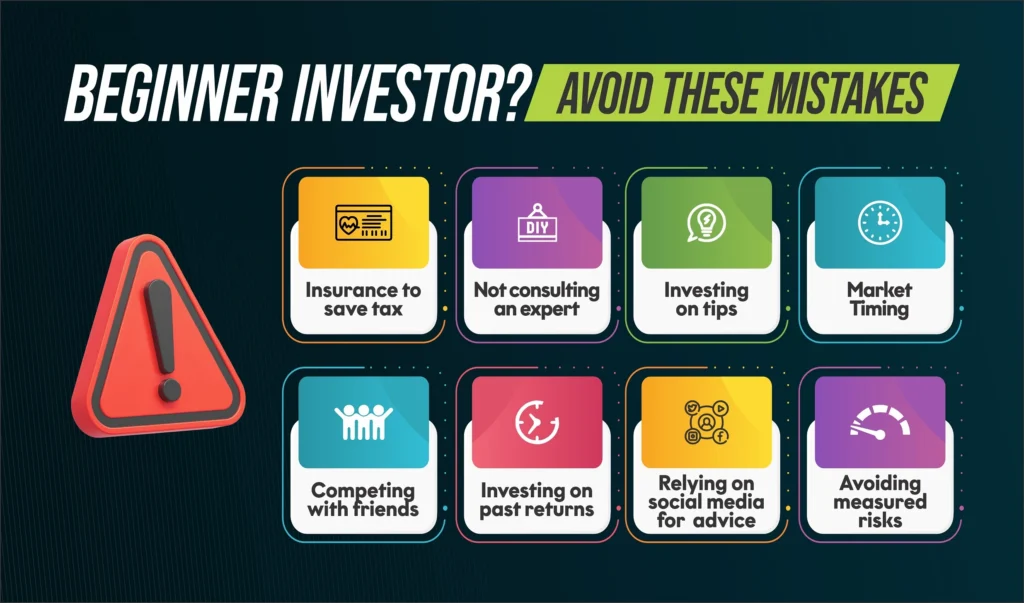
- Emotional investing: The market runs on fear and greed. Beginners often buy when the market is high (greed) and sell when it crashes (fear). This is the opposite of “buy low, sell high.”
- Chasing trends: Whether it’s a meme stock or a trendy cryptocurrency, chasing what is “hot” usually leads to losses. By the time you hear about it, the smart money has often already moved on.
- Ignoring fees: A 1% fee sounds small, but over 30 years, it can reduce your total portfolio value by tens of thousands of dollars. Always look for low expense ratios.
Simple Steps to Start Investing in the USA
Ready to begin? Here is how to start investing in the USA:
- Set financial goals: Know why you are investing (Retirement? House? Wealth?).
- Open an investment account: If your employer offers a 401(k) match, start there. If not, open a Roth IRA or a standard brokerage account at a firm like Vanguard, Fidelity, or Charles Schwab.
- Choose beginner-friendly investments: For most beginners, a low-cost “Target Date Fund” or a broad market “Index ETF” (like a Total Stock Market fund) is the best starting point. These handle diversification for you.
Long-Term Investing vs Short-Term Trading
It is crucial to distinguish between long term investing in the USA and trading. Trading is trying to time the market to make quick profits. It is stressful, difficult, and usually results in losses for beginners. Investing is holding assets for years.
- Compounding benefits: Compounding needs time to work. The longer your money stays invested, the faster it grows.
- Market volatility perspective: The stock market has crashed many times in history. Every single time, it has eventually recovered and reached new highs.
- Patience and discipline: The most successful investors are often the ones who check their accounts the least. They set up automatic contributions and let the market do the heavy lifting.
Frequently Asked Questions (FAQ)
Q1. What is the best investment option for beginners in the USA?
For most beginners, broad-market Index Funds or ETFs (like an S&P 500 ETF) are ideal. They offer instant diversification, low fees, and require very little maintenance.
Q2. How much money should beginners invest first?
You should only invest money you won’t need for at least 3 to 5 years. Before investing, ensure you have an emergency fund (3-6 months of expenses) in a savings account.
Q3. Are stocks too risky for beginners?
Individual stocks can be risky, but investing in the stock market as a whole (via index funds) is considered the best way to build long-term wealth, despite short-term volatility.
Q4. What’s safer: bonds or stocks?
Bonds are generally safer and less volatile than stocks. However, over the long term, stocks have historically provided significantly higher returns than bonds.
Q5. Can beginners invest without a financial advisor?
Yes. With the rise of user-friendly apps, robo-advisors, and easy-access index funds, beginners can effectively manage their own portfolios without paying high advisor fees.
Q6. How long should beginners keep their investments?
Ideally, as long as possible. The stock market is best suited for goals that are at least 5 to 10 years away.
Q7. Is investing better than saving money in a bank?
For long-term goals, yes. Savings accounts rarely keep up with inflation. Investing allows your money to grow faster than the cost of living increases.
Start Small, Think Long-Term
Investing is a journey, not a race. You do not need to be a Wall Street expert or a mathematician to succeed. You simply need consistency. By starting early, minimizing fees, and utilizing the powerful investment options available in the USA, you can secure your financial future.
Don’t wait for the “perfect” time to start. The best time to plant a tree was 20 years ago; the second-best time is today. Open an account, buy a diversified fund, and let time work its magic.