


There are ten seconds left on the clock. The stadium is shaking, a deafening wall of noise generated by 80,000 screaming fans. A quarterback steps to the line of scrimmage. Physically, he is exhausted. His heart rate is spiking, and his body is bruised from three quarters of punishment. But in his mind, the stadium is silent. The chaos slows down. He isn’t thinking about the millions of dollars on the line or the legacy he will leave behind. He is thinking about one thing: the snap count.
This ability to quiet the noise—both internal and external—is rarely accidental. For decades, we believed that “clutch” performance was an innate trait, something you were either born with or you weren’t. We lionized athletes like Michael Jordan or Tom Brady for their icy veins, assuming it was just part of their DNA.
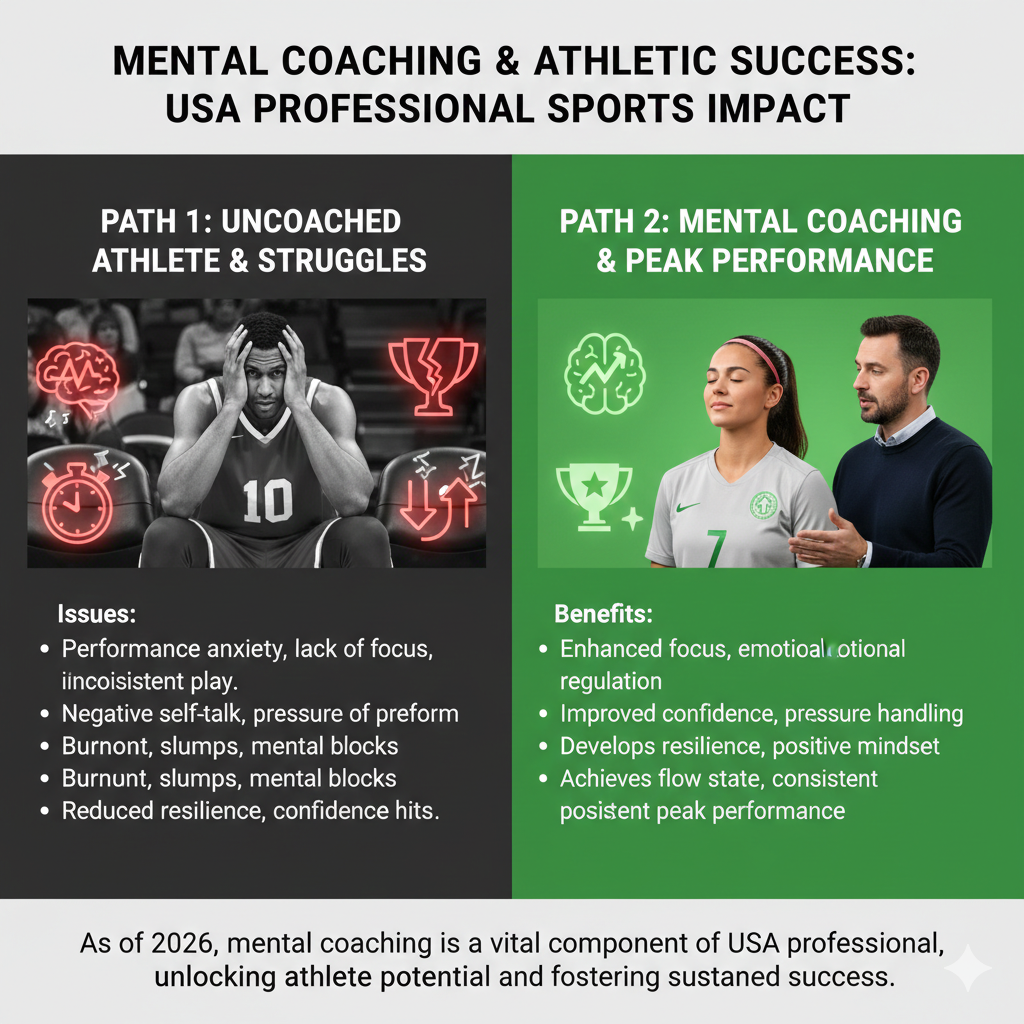
While natural temperament plays a role, we now know that mental resilience is a skill, just like a jump shot or a curveball. It can be trained, sharpened, and optimized. This realization has ushered in a new era in American professional sports. From the NFL to the NBA, franchises are no longer just investing in weight rooms and nutritionists; they are investing heavily in the mind. This is the rise of mental coaching, the final frontier of elite athletic performance.
What Is Mental Coaching in Sports?
At its simplest level, mental coaching is strength and conditioning for the brain. Just as a physical trainer helps an athlete build muscle to run faster or hit harder, a mental coach helps an athlete build cognitive frameworks to focus better and recover faster from failure.
Definition and core principles
Mental coaching involves teaching athletes specific psychological skills to enhance performance and personal well-being. The core principles revolve around self-regulation, visualization, and cognitive restructuring. It is not about giving pep talks. It is about equipping athletes with a toolbox they can open in the heat of battle. When a pitcher gives up a home run, what is the specific mental routine to reset before the next batter? That is the domain of mental coaching.
Difference between mental coaching and therapy
There is often confusion between mental performance coaching and clinical therapy, though the lines are blurring. Clinical therapy generally focuses on mental health conditions like depression, trauma, or generalized anxiety, aiming to bring a person from a place of dysfunction to a place of baseline health.
Mental coaching, conversely, is often about taking a healthy individual and optimizing them for elite output. It focuses on the “how” of performance: how to maintain confidence, how to set goals, and how to execute under pressure. While a therapist might ask, “Why do you feel sad?” a mental coach asks, “How can we get you to focus on the rim when the game is tied?”
Why Mental Coaching Matters in Professional Sports
At the professional level—whether it’s the MLB, NFL, NHL, or NBA—the physical gap between players is negligible. Everyone is fast. Everyone is strong. Everyone was the best player in their college or high school. The differentiator is rarely physical talent; it is mental application.
Pressure, expectations, and media scrutiny
The modern athlete operates in a fishbowl. Every mistake is GIF-ed, meme-d, and dissected on social media within seconds. The 24-hour news cycle creates a pressure cooker that didn’t exist thirty years ago. Mental coaching provides a shield against this scrutiny, teaching athletes to separate their self-worth from their statistical output and the opinions of strangers on the internet.
Marginal gains at elite performance levels
In the Olympics or the Super Bowl, the difference between gold and silver, or winning and losing, is often measured in milliseconds or inches. When physical training yields diminishing returns because the body is already at peak condition, the mind offers a vast, untapped reservoir of potential improvement. Gaining a 1% mental edge can be the difference between a Hall of Fame career and being a journeyman.
Key Areas Where Mental Coaching Impacts Athletes
The impact of mental training isn’t abstract; it shows up in specific, tangible areas of gameplay.
Focus and Concentration
In-game decision-making:
Sports are chaos. A point guard in the NBA has a fraction of a second to decide whether to drive, pass, or shoot, all while reading the defense. Mental coaching improves cognitive processing speed and situational awareness, allowing the game to “slow down” for the athlete.
Minimizing distractions:
Distractions are everywhere—from a heckling fan in the front row to a bad call by a referee. Mental coaches teach “cue words” or physical triggers (like adjusting gloves or taking a deep breath) to bring an athlete’s focus back to the immediate task, blocking out irrelevant data.
Confidence and Self-Belief
Performance consistency:
Confidence can be fragile. A striker might go five games without a goal and start doubting their entire skillset. Mental coaching instills “process-oriented” thinking. Instead of focusing on the result (the goal), the athlete focuses on the process (making the right run). This stabilizes confidence because the process is within their control, whereas the result often isn’t.
Handling slumps and criticism:
Slumps are inevitable. The mental coach helps the athlete reframe the slump not as a loss of ability, but as a statistical variance or a learning opportunity. This reframing prevents a bad week from turning into a bad season.
Stress and Pressure Management
High-stakes moments:
Physiologically, excitement and fear look very similar—elevated heart rate, sweaty palms, adrenaline dump. Mental coaches teach athletes to interpret these signals as “readiness” rather than “anxiety.” This shift in perspective allows a kicker to view a game-winning field goal as an opportunity to shine rather than a catastrophic risk of failure.
Playoff and championship environments:
The playoffs are a different beast. The intensity creates tunnel vision. Mental training helps athletes maintain a wide field of vision and relaxed muscles, counteracting the body’s natural “fight or flight” response which creates stiffness and poor execution.
Emotional Regulation
Controlling frustration and anxiety:
We’ve all seen an athlete implode after a bad play, committing a foolish penalty out of anger. Emotional regulation techniques help athletes acknowledge the anger without acting on it.
Staying composed under pressure:
Composure is the ability to execute fine motor skills when the nervous system is screaming. Through breathing techniques and biofeedback training, athletes learn to manually lower their arousal levels to stay in the “zone.”
Mental Coaching and Performance Outcomes
The ROI of mental coaching is seen in the stats sheet and the win column.
Improved consistency
The hallmark of a great pro is not one amazing game, but 82 solid games. Mental routines create a baseline of performance that holds up even when the athlete doesn’t “feel” their best physically.
Faster recovery from mistakes
In the NFL, a cornerback gets beat for a touchdown. He has 40 seconds before he has to cover the same receiver again. If he is still thinking about the touchdown, he will get beat again. Mental coaching creates a “flush it” mechanism, allowing for near-instant memory erasure of negative outcomes.
Enhanced clutch performance
“Clutch” is simply the absence of panic. By normalizing high-pressure situations through visualization, the actual event feels like a memory rather than a shock. The athlete feels they have been there before, because in their mind, they have.
Role of Mental Coaching in Injury Recovery
Perhaps the most overlooked aspect of sports psychology is the rehab room. An ACL tear is a physical trauma, but the recovery is a mental marathon.
Coping with setbacks
Long-term injuries lead to isolation. The athlete is away from the team, the locker room banter, and their identity. Mental coaches provide strategies to cope with this loss of identity and the grind of daily physical therapy.
Maintaining motivation during rehab
As the body heals, the mind often lags. Athletes frequently experience “kinesiophobia”—the fear of movement or re-injury. Even when physically cleared, they may hesitate. Mental coaching bridges this gap, rebuilding trust in the body so the athlete can return to play without hesitation.
Mental Coaching Across Major U.S. Sports
Each league has its unique psychological demands.
NFL mental preparation
Football is a collision sport played like chess. The mental load is immense due to the complexity of playbooks. Mental coaching in the NFL focuses heavily on information processing and “next play” mentality. With only 17 games in a season, the weight of a single loss is crushing; resilience is the primary commodity.
NBA performance psychology
Basketball is a game of runs and rhythm. It is highly individualistic within a team concept. Performance psychology here often deals with the “hot hand” fallacy and isolation. Because players are so visible (no helmets/pads) and close to fans, blocking out external noise is a major focus.
MLB focus and routine building
Baseball is a game of failure. A batter who fails 70% of the time is an All-Star. Consequently, MLB mental coaching is deeply rooted in managing failure and routine. Baseball players are notoriously superstitious; mental coaches work to turn superstitions into productive, grounding routines.
NHL resilience and toughness
Hockey culture prizes toughness, often to a fault. Mental coaching in the NHL is evolving to help players differentiate between “playing through pain” (grit) and hiding serious issues. It also focuses on the intense speed of the game, requiring rapid-fire decision-making skills.
Team-Level Benefits of Mental Coaching
It’s not just about the individual; it’s about the collective mind.
Leadership development
Captains aren’t just born; they are developed. Mental coaches work with team leaders to improve emotional intelligence, helping them understand how to motivate different personality types within the locker room.
Communication and trust
Breakdowns in defense often stem from breakdowns in communication. Mental training exercises improve verbal and non-verbal communication, fostering a sense of trust where teammates know exactly where the other will be.
Team culture and cohesion
A fragmented locker room sinks championships. Mental coaches facilitate sessions that build shared values and a collective identity (“Us against the world”), which acts as a buffer when the team hits a losing streak.
Mental Coaching Tools and Techniques
How do they actually do it? Here are the trade secrets.
Visualization and imagery
Athletes are taught to visualize not just success, but problems. They visualize the perfect swing, but they also visualize their equipment breaking or the crowd booing, so they can practice their response. This is called “adversity training.”
Goal setting and routines
This goes beyond “I want to win.” It involves setting process goals (e.g., “I will keep my head down on the follow-through”) that are actionable and measurable. Pre-game and pre-shot routines trigger the brain to enter performance mode.
Breathing and mindfulness techniques
Box breathing (inhale 4, hold 4, exhale 4, hold 4) is a common tool used on sidelines to down-regulate the nervous system. Mindfulness apps and meditation are now standard prescriptions for rookies to improve sleep and reduce anxiety.
Stigma Reduction Around Mental Health in Sports
We have witnessed a massive cultural shift. Twenty years ago, seeing a “shrink” was a secret kept to save a career. Today, it is a status symbol of a serious professional.
Cultural shift in professional leagues
Leagues are now mandating mental health resources. The “suck it up” mentality, while still present, is fading. Front offices realize that ignoring the mind is like ignoring a torn hamstring—it’s bad business.
Athlete advocacy and openness
Icons like Kevin Love, DeMar DeRozan, Simone Biles, and Michael Phelps have opened the door. By speaking publicly about anxiety and depression, they have normalized the conversation. They proved that you can be an elite competitor and still struggle, making it acceptable for the next generation to seek help.
Challenges and Limitations of Mental Coaching
Despite the progress, hurdles remain.
Buy-in from athletes
You can lead a horse to water, but you can’t make him meditate. Some “old school” athletes still view mental training as softness or voodoo. Winning over the skeptics requires showing tangible, data-backed results.
Measuring mental performance ROI
How do you measure confidence? Unlike a 40-yard dash time or a bench press max, mental improvements are qualitative. This makes it hard for some organizations to justify the budget for extensive mental conditioning departments, although this is changing as analytics get smarter.
Is Mental Coaching Becoming Standard in Pro Sports?
Integration with training staff
Mental coaches are no longer consultants flown in for a crisis; they are on the payroll. They sit in meetings with the strength coach and the head coach. The integration is holistic—mind and body are treated as one unit.
Long-term adoption trends
Youth academies and collegiate programs are now hiring mental coaches. By the time a player reaches the pros in 2030, they will likely have been doing mental drills since they were 12. It will be as standard as stretching.
Future of Mental Coaching in the USA
The future is personalized and tech-driven.
Personalized mental training programs
Just as nutrition is tailored to a player’s blood type and metabolism, mental training will be tailored to personality profiles. Assessments will determine if a player needs anger management or arousal elevation, and programs will be customized accordingly.
Tech-assisted mental performance tools
Virtual Reality (VR) is the next big wave. Quarterbacks can take 100 mental reps against a specific defense in a VR headset without taking a single physical hit. Biofeedback wearables will alert coaches when a player’s stress levels are spiking in real-time, allowing for immediate intervention.
The era of ignoring the mind is over. In the high-stakes world of American professional sports, where everyone is a physical giant, the mental coach is the architect of the ultimate competitive advantage.
FAQs – Mental Coaching in Professional Sports
Does mental coaching really improve performance?
Yes. Studies and anecdotal evidence from elite athletes consistently show that mental skills training improves focus, consistency, and the ability to perform under pressure, leading to better statistical outcomes.
How is mental coaching different from sports psychology?
While the terms are often used interchangeably, sports psychology is the broader scientific field. Mental coaching is the practical application of that science. A sports psychologist might conduct research or treat clinical issues, while a mental coach is on the field focusing specifically on performance optimization.
Do all pro teams use mental coaches?
Most do. In the NFL, MLB, and NBA, the vast majority of teams employ either full-time mental performance coaches or retain consultants who work with players regularly.
Can mental coaching help injured athletes?
Absolutely. It is one of the most critical applications. It helps athletes maintain their identity, stay motivated during rehab, and overcome the fear of re-injury when they return to play.
Is mental coaching only for elite players?
No. While it started at the top, mental coaching is trickling down to college, high school, and even youth sports. The skills taught—focus, resilience, and emotional control—are valuable for athletes at every level.