


The United States is often defined by its hustle culture. From Silicon Valley startups to Wall Street boardrooms, there is a pervasive belief that doing more is always better. But for many American professionals, the reality of “having it all” feels more like “doing it all”—and often, doing it all poorly.
We live in an era where the boundary between work and life has blurred significantly. Emails ping at dinner, Slack notifications interrupt weekends, and the mental load of managing a household while climbing the corporate ladder can feel crushing. This constant state of connectivity and demand has led to a national epidemic of burnout.
However, the antidote isn’t necessarily working harder or sleeping less. It lies in effective time management. This isn’t just about color-coding a calendar or squeezing five extra minutes out of a commute. True time management is a tool for life design. It empowers you to align your daily actions with your deeper values, reducing stress and ultimately reclaiming your quality of life.
What Is Time Management?
At its core, time management is the deliberate process of planning and exercising conscious control of time spent on specific activities to increase effectiveness, efficiency, and productivity. But for the modern professional, that definition needs an update.
Time management is less about managing the clock and more about managing your energy and attention. It is the art of deciding what not to do as much as what to do.
Time management vs. being busy
There is a critical distinction between being busy and being productive. Being busy often means operating in a reactive state—putting out fires, responding immediately to every notification, and feeling exhausted by 5 PM with little to show for it.
Effective time management shifts you into a proactive state. It prioritizes high-value tasks that move the needle on your goals. You might actually “do” fewer things in a day, but the impact of those actions is significantly higher. It’s the difference between running on a hamster wheel and running a marathon; both require effort, but only one gets you to a finish line.
Why Time Management Matters in the USA
The American lifestyle presents unique challenges that make time management not just a skill, but a survival mechanism. The U.S. worker puts in more hours annually than counterparts in many other developed nations. This intensity, combined with a culture that often equates self-worth with output, creates a perfect storm for stress.
Fast-paced lifestyles and burnout
Burnout is officially recognized by the World Health Organization as an occupational phenomenon, and it is rampant in the United States. The pressure to keep up with a fast-paced economy means many professionals operate in a chronic state of “fight or flight.” Without structured time management, this pace is unsustainable. It leads to physical exhaustion, cynicism, and a sense of inefficacy.
Competing work, family, and personal demands
For the average American, the workday doesn’t end when the laptop closes. There are side hustles, family obligations, social expectations, and the maintenance of personal health. Without a system to organize these competing demands, one area inevitably suffers. Usually, it’s the personal pillars—sleep, exercise, and downtime—that are sacrificed first, leading to a degradation of overall life quality.
How Poor Time Management Affects Life Quality
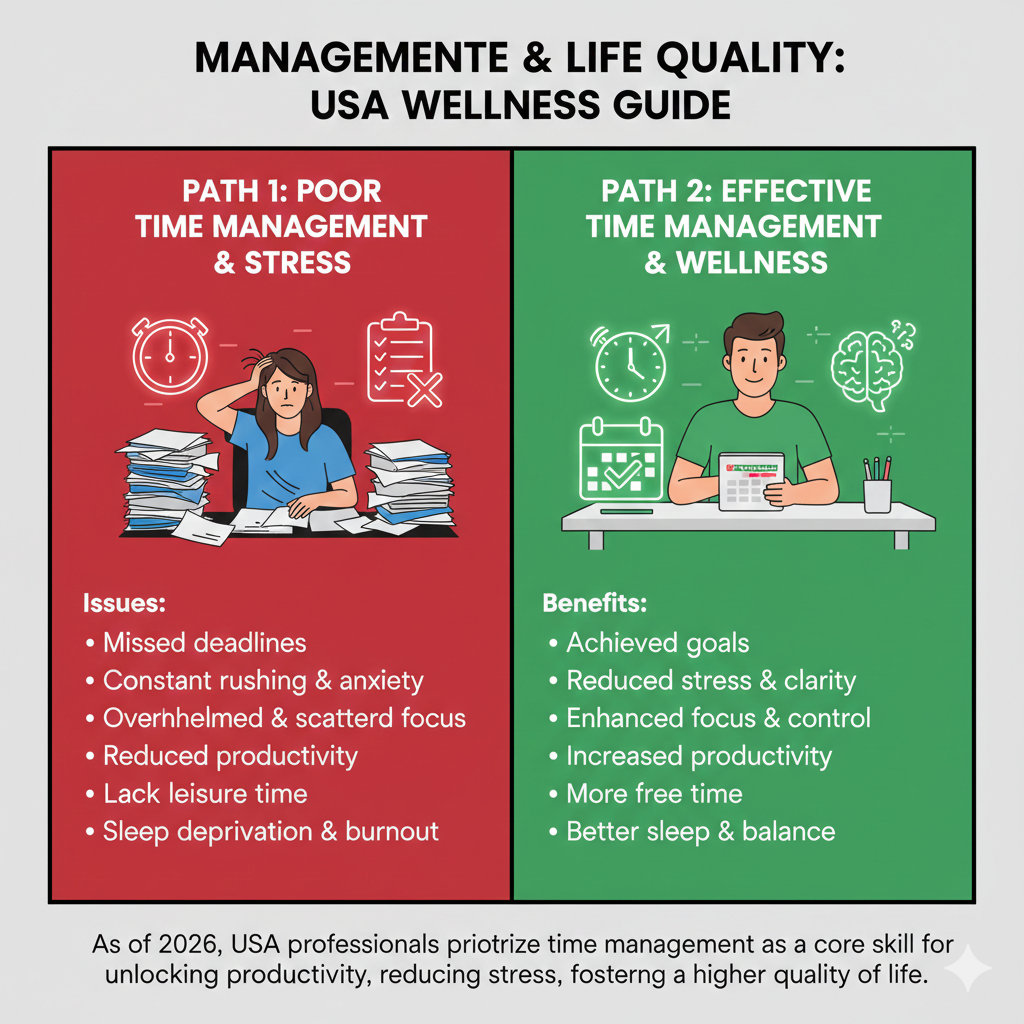
When we fail to manage our time, the consequences ripple outward, affecting far more than just missed deadlines.
Chronic stress and overwhelm
The feeling of always being “behind” triggers a constant release of cortisol, the stress hormone. Over time, this chronic stress manifests physically—headaches, insomnia, high blood pressure—and mentally, creating a fog of anxiety that makes simple decision-making difficult. You end up living in a state of triage, reacting to the loudest problem rather than the most important one.
Missed priorities and fatigue
Poor time management often looks like procrastination on big projects followed by panicked, all-night sprints to finish them. This “boom and bust” cycle destroys consistent energy levels. Furthermore, when you are constantly rushing, you miss the priorities that truly matter: the recital, the anniversary dinner, or the preventative doctor’s appointment.
How Time Management Improves Life Quality
Implementing robust time management strategies acts as a buffer against the chaos of modern life. It creates space for the things that make life worth living.
Reduced Stress and Anxiety
Knowing exactly what needs to be done—and crucially, when it will get done—quiets the mind. When you have a plan, you stop worrying about what you might be forgetting. This clarity significantly lowers daily anxiety levels. You can focus on the task at hand without the nagging feeling that you should be doing something else.
Improved Productivity and Focus
By intentionally allocating time for deep work, you train your brain to focus. Instead of multitasking (which studies show lowers IQ and efficiency), you practice “monotasking.” You produce higher quality work in less time, freeing up hours that were previously lost to distraction and task-switching costs.
Better Work-Life Balance
Work-life balance is elusive, but time management makes it attainable. By setting hard boundaries—like “no emails after 6 PM” or “Sundays are for family”—you protect your personal time. You learn to leave work at work, physically and mentally, allowing you to be fully present during your off hours.
More Time for Health and Relationships
This is perhaps the most tangible benefit. When you aren’t working 60-hour weeks to catch up on tasks that should take 40, you reclaim time for the gym, for cooking healthy meals, and for sleeping eight hours. You also find the bandwidth to call friends and spend uninterrupted time with your partner or children, strengthening the social bonds that are essential for happiness.
Time Management and Mental Well-Being
The psychological benefits of managing your schedule are profound.
Sense of control and confidence
Psychologists note that a sense of autonomy is a key driver of well-being. When you manage your time, you feel in control of your life rather than a victim of circumstance. This fosters self-efficacy and confidence. You trust yourself to follow through on commitments, which builds self-esteem.
Reduced decision fatigue
We make thousands of decisions a day. By planning your week in advance, you automate many of these choices. You don’t have to decide what to work on Tuesday morning because you decided it on Sunday night. This preservation of mental energy leaves you with more willpower to handle unexpected challenges or emotional stressors.
Time Management at Work
For the career-focused individual, efficiency is the currency of advancement.
Task prioritization
Successful professionals don’t just work hard; they work smart. They use time management to identify the 20% of tasks that yield 80% of the results (the Pareto Principle). They tackle high-impact projects when their energy is highest and save administrative tasks for low-energy periods.
Fewer last-minute deadlines
Proactive planning eliminates the adrenaline-fueled rush of last-minute submissions. This not only improves the quality of the output but also positions you as a reliable, composed leader. You become the person who is prepared, not the person who is scrambling.
Higher job satisfaction
When you are constantly overwhelmed, you resent your job. When you are on top of your workload, you have the mental space to find meaning in it. You can engage in creative problem-solving and professional development, leading to greater career fulfillment and reduced turnover intention.
Time Management in Personal Life
The skills used in the boardroom apply equally to the living room.
Family time and hobbies
Scheduling isn’t just for meetings; it’s for joy. By blocking out time for hobbies—whether it’s painting, hiking, or coding—you ensure they actually happen. Similarly, scheduling family time signals to your loved ones that they are a priority, not an afterthought.
Rest and recovery
In the U.S., rest is often viewed as laziness. Time management reframes rest as a necessary productive activity. It allows you to schedule downtime without guilt, knowing that your responsibilities are handled. This “intentional idleness” is where creativity and recovery happen.
Common Time Management Mistakes
Even with good intentions, many professionals fall into traps that sabotage their efforts.
Overcommitting
The inability to say “no” is a primary thief of time. We often underestimate how long tasks take and overestimate our energy levels. Overcommitting leads to a calendar that is mathematically impossible to complete, setting you up for failure before the day begins.
Multitasking
Despite the badge of honor often associated with it, multitasking is a myth. The brain cannot perform two complex cognitive tasks simultaneously; it switches rapidly between them. This switching incurs a “cognitive tax,” lowering efficiency and increasing error rates.
Poor planning
Starting the day without a plan is like driving without a map. You might move fast, but you might be going in the wrong direction. Reacting to email inboxes usually dictates the day for those who fail to plan proactively.
Practical Time Management Techniques
To move from theory to practice, consider these proven methodologies.
Time blocking
This involves dividing your day into blocks of time, each dedicated to a specific task or group of tasks. For example, 9:00 AM to 11:00 AM might be blocked for “Deep Work/Project A,” while 1:00 PM to 2:00 PM is for “Email and Admin.” This prevents tasks from expanding to fill the whole day.
Priority matrices
The Eisenhower Matrix is a classic tool that categorizes tasks into four quadrants: Urgent/Important, Not Urgent/Important, Urgent/Not Important, and Not Urgent/Not Important. It helps you distinguish between tasks that merely feel urgent (like a ringing phone) and tasks that are truly important for your long-term goals.
Daily and weekly planning
Spend 15 minutes on Friday afternoon or Sunday evening planning the week ahead. Identify your “Big Three”—the three most important things you must accomplish that week. Each morning, review your plan and adjust as necessary. This small investment of time saves hours of confusion later.
Role of Technology in Time Management
In the digital age, technology is both a tool and a trap.
Productivity apps and tools
utilized correctly, apps like Asana, Trello, or simple calendar apps act as an external brain. They hold your to-do lists and deadlines so your mind doesn’t have to. Automation tools can also handle repetitive tasks, freeing up your time for high-level thinking.
Managing digital distractions
Technology also presents the biggest challenge to time management. Apps that block social media sites (like Freedom or Cold Turkey) or “Focus Modes” on smartphones are essential for maintaining deep concentration in an attention economy designed to distract you.
Time Management Across Life Stages
Strategies must evolve as your career and life progress.
Students and young professionals
At this stage, the focus is often on building habits and learning to manage autonomy. The challenge is balancing intense learning curves or study loads with social lives. Tools like the Pomodoro technique (25 minutes of work, 5 minutes of break) are highly effective here.
Working parents
This is the “rush hour” of life. Time management becomes a game of logistics. Shared family calendars, meal prepping, and outsourcing tasks (like grocery delivery or cleaning) become investments in sanity rather than luxuries.
Mid-career and senior professionals
As responsibilities grow, time management shifts from “doing” to “delegating.” The goal is to protect time for strategic thinking and mentoring. The challenge is learning to let go of lower-level tasks that you are good at but shouldn’t be doing anymore.
Building Sustainable Time Management Habits
The goal is not to be a robot, but to build a sustainable lifestyle.
Small changes over perfection
Don’t try to overhaul your entire life overnight. Start by implementing one technique, like time-blocking your mornings. Once that sticks, add another.
Consistency over intensity
It is better to be moderately organized every day than perfectly organized once a month. Consistency builds the neural pathways that turn effortful planning into automatic habit.
Long-Term Impact of Good Time Management
When you zoom out, the compounding effects of managing your time are staggering.
Better health outcomes
Lower stress levels over decades reduce the risk of heart disease, anxiety disorders, and other stress-related ailments. You quite literally add years to your life.
Improved life satisfaction
People who manage their time report higher levels of happiness. They feel they are living a life of their own design, filled with activities and people they value.
Long-term goal achievement
Writing a book, starting a business, or retiring early doesn’t happen by accident. These are the results of thousands of hours of focused effort, made possible only through effective time management.
FAQs – Time Management and Life Quality
How does time management reduce stress?
Time management provides structure and predictability. It moves you from a reactive state (panicking about deadlines) to a proactive state (working according to a plan). This sense of control lowers cortisol levels and reduces the mental load of constantly trying to remember what needs to be done.
Can time management really improve life quality?
Absolutely. By creating efficiency in your work, you reclaim time for sleep, exercise, relationships, and hobbies—the pillars of a high-quality life. It allows you to be present in the moment rather than mentally distracted by a to-do list.
What is the biggest time management mistake?
The biggest mistake is usually underestimating how long tasks take and overestimating how much focus you have. This leads to overcommitting, which results in failure, stress, and a lack of trust in your own schedule.
How long does it take to see results?
You can feel the relief of a brain dump or a prioritized list immediately. However, changing deep-seated habits takes time. Expect to see significant, sustainable changes in your productivity and stress levels after about 30 to 60 days of consistent practice.
Are productivity tools necessary for time management?
No, they are not strictly necessary—a pen and paper work fine. However, for complex modern workflows involving teams and digital deliverables, tools can significantly streamline the process and serve as a reliable “external brain.”
Creating a Life by Design
In the United States, where the culture often glorifies exhaustion, choosing to manage your time is a radical act of self-care. It is a declaration that your time is valuable and that your life belongs to you, not your inbox. By mastering these skills, you aren’t just becoming a better employee; you are building a richer, healthier, and more fulfilling life.