


The U.S. power grid is a complex machine, a web of wires, substations, and generation plants designed to keep the lights on for over 330 million people. Usually, it works seamlessly in the background. But every so often, nature throws a curveball that exposes just how fragile this essential infrastructure really is. The massive winter storm sweeping across the country in January 2026 is one of those moments.
From the Pacific Northwest to the deep freeze gripping the Midwest and extending into the usually temperate South, this isn’t just another weather event. It is a stress test of national proportions, challenging the resilience of our aging infrastructure and the planning models we rely on. As heating systems kick into overdrive and ice begins to accumulate on transmission lines, grid operators are watching monitors with bated breath, balancing the thin line between supply and demand.
This post breaks down exactly why this specific storm is pushing the grid to its absolute limits, the technical challenges happening behind the scenes, and what this event reveals about the future of energy reliability in America.
Why the January 2026 Storm Is Different
Meteorologists often talk about “once-in-a-generation” storms, but for grid operators, the frequency of these extreme events is alarming. The January 2026 winter storm is unique because of its sheer geographic scope and the specific combination of weather hazards it presents.
Unlike localized blizzards that affect a single region, this system has draped a curtain of arctic air over nearly two-thirds of the continental United States. This widespread cold creates a nightmare scenario for grid reliability: simultaneous stress. Usually, if the Midwest is freezing, the South might be mild, allowing power to be imported from one region to another. But when everyone is freezing at the same time, there is no surplus power to share.
Furthermore, the duration of the cold snap is compounding the problem. A 24-hour freeze is manageable; a week-long deep freeze depletes fuel reserves, freezes natural gas wellheads, and prevents solar panels from clearing snow. It is a battle of attrition where the grid’s resources are slowly worn down day by day.
How Extreme Cold Pushes the Power Grid to the Brink
When temperatures drop, electricity demand spikes violently. This is a fundamental reality of the power sector. In many parts of the U.S., homes and businesses rely on electric resistance heating or heat pumps. When the mercury plunges below zero, these systems run continuously, pulling massive amounts of current from the grid.
This phenomenon creates a “winter peak” that rivals the hottest days of summer. However, winter peaks are often more dangerous because they tend to happen early in the morning (as people wake up and turn up thermostats) and late in the evening (when solar generation has ceased).
This January 2026 winter storm has created a “double peak” situation where demand remains dangerously high throughout the day, never giving the equipment a chance to cool down or reset. Grid operators operate with a “reserve margin”—extra power capacity kept on standby for emergencies. During this storm, those margins have evaporated, leaving operators with zero room for error. If a single large power plant trips offline due to mechanical failure, there isn’t enough backup capacity to fill the void.
Ice, Wind, and Snow vs Power Infrastructure
While cold drives up demand, precipitation destroys the means of delivery. The January 2026 storm has brought a trifecta of physical threats: heavy snow, high winds, and, most destructively, freezing rain.
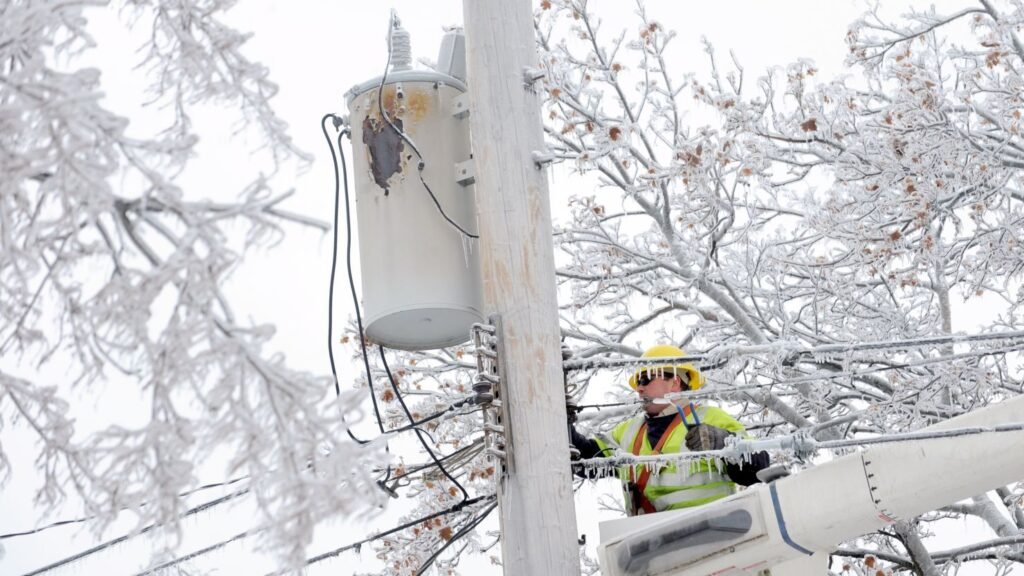
Ice accumulation is the silent killer of grid infrastructure. Just a half-inch of ice on a power line can add 500 pounds of extra weight to a single span of wire. When you combine that weight with wind gusts, the structural integrity of transmission towers and distribution poles fails. Lines snap, and towers crumple.
The damage isn’t limited to the equipment itself. Ice-laden tree branches snap and fall onto distribution lines, causing thousands of localized outages that are difficult to pinpoint and repair. This creates a logistical nightmare during the storm. Even if there is enough power being generated, the “last mile” of delivery is severed. Making matters worse, the hazardous road conditions prevent repair crews from reaching the damage sites quickly, extending outage durations from hours to days.
Generation Challenges During Winter Storms
A common misconception is that outages are solely caused by downed wires. In reality, the problem often starts at the source: the power plants themselves. The January 2026 storm has exposed significant vulnerabilities in our ability to generate power during extreme cold.
Natural gas, which provides the largest share of U.S. electricity, faces a unique hurdle known as “freeze-offs.” This occurs when water vapor in natural gas pipelines freezes at the wellhead, blocking the flow of fuel. Without fuel, gas-fired power plants cannot run, exactly when they are needed most. We saw this during Winter Storm Uri in 2021, and despite upgrades, the magnitude of the 2026 freeze is testing those winterization efforts severely.
Renewables face their own hurdles. While wind turbines can produce significant power during winter, they must be equipped with de-icing packages to function in freezing rain—equipment not installed on every turbine. Similarly, heavy snow cover can block solar arrays, reducing their output to near zero. Traditional coal and nuclear plants are generally more resilient to on-site fuel issues but are not immune; frozen instrumentation lines or cooling water intakes can force these baseload giants offline unexpectedly.
Transmission Bottlenecks and Regional Grid Stress
The U.S. power grid is effectively divided into three major interconnections: the East, the West, and Texas (ERCOT). Moving power between these massive regions is notoriously difficult due to limited transmission capacity.
During the January 2026 storm, we are seeing severe transmission bottlenecks. Even if the Pacific Northwest has excess hydropower, the transmission “highways” to move that electrons to the shivering Midwest are congested or nonexistent. It’s the electrical equivalent of a traffic jam; there is simply no more room on the road.
This regional isolation forces grid operators to be self-sufficient. When local generation fails, they cannot easily import emergency power from neighbors who are also struggling. This lack of interregional connectivity is a known weakness that policy experts have warned about for decades, yet construction of new high-voltage transmission lines remains slow and bureaucratically complex.
Aging Infrastructure Meets Extreme Weather
A significant portion of the U.S. grid was built in the 1960s and 70s. Transformers, breakers, and transmission lines have exceeded their intended lifespans. We are essentially trying to run a modern, digital economy on analog, mid-century hardware.
This aging infrastructure is less resilient to physical stress. Old metal becomes brittle in extreme cold; insulation on underground cables cracks. The January 2026 storm is exploiting these weaknesses. Equipment that might function fine at 40 degrees Fahrenheit is failing catastrophically at -10 degrees.
This highlights a massive funding gap. Updating the grid requires hundreds of billions of dollars in investment. While recent federal infrastructure bills have allocated funds for modernization, the pace of physical upgrades lags behind the increasing frequency of extreme weather events. The storm is effectively locating every deferred maintenance project and forcing a failure.
Rolling Blackouts and Emergency Measures Explained
When the equation of supply and demand becomes unbalanced, grid operators have one final, drastic tool: load shedding, commonly known as rolling blackouts.
This is a controlled emergency measure designed to prevent a total grid collapse. If demand exceeds supply, the frequency of the grid drops. If it drops too low, it can physically damage generators, causing them to disconnect automatically to protect themselves. This can lead to a cascading failure where the entire grid goes dark for weeks (a “black start” scenario).
To prevent this, operators intentionally cut power to blocks of customers for defined periods (e.g., 45 minutes). It is a painful choice, but a necessary one to keep the overall system alive. However, during the January 2026 storm, we are seeing that “controlled” outages are difficult to manage. In some areas, equipment that is turned off freezes in the “open” position and cannot be turned back on, turning a 45-minute rolling blackout into a multi-day outage.
Lessons from Past Grid Crises
History has a habit of repeating itself in the energy sector. The 2011 Southwest Cold Weather Event, the 2014 Polar Vortex, and the 2021 Texas Freeze all provided clear warnings.
The lesson from these past crises was that the U.S. grid is not built for the extremes of climate change. Post-2021, recommendations were made to weatherize gas infrastructure and increase interregional transmission. The January 2026 storm serves as a report card on those efforts.
While some progress has been made—grid operators are better at forecasting demand and communicating with the public—the structural issues remain. We are still overly reliant on just-in-time fuel delivery for natural gas, and our transmission system remains fragmented. The warning signs were there; the 2026 storm is the realization of those unaddressed risks.
How Utilities and Grid Operators Are Responding
Despite the grim circumstances, the response from utility workers has been heroic. Line workers are battling sub-zero temperatures and gale-force winds to restore power.
Behind the scenes, grid operators (ISOs and RTOs) are coordinating like never before. They are issuing public conservation alerts earlier, asking consumers to lower thermostats before the crisis peaks. Mutual aid agreements are in full swing, with crews from unaffected areas (and even Canada) driving into the storm zone to assist with repairs.
Operators are also prioritizing critical infrastructure, ensuring that hospitals, fire stations, and water treatment plants remain energized even during load shedding events. This triage approach saves lives, even if it means residential neighborhoods go dark.
What This Storm Reveals About Grid Resilience
The January 2026 storm is clarifying the link between climate change and energy security. We can no longer plan the grid based on the weather patterns of the past 50 years. “Extreme” is the new normal.
This event underscores the urgent need for a two-pronged approach: winterization and modernization. We need power plants that are enclosed and heated. We need transmission lines that are buried or reinforced. But beyond hardware, we need regulatory reform that incentivizes reliability over pure cost-savings.
The grid of the future must be flexible. It needs to integrate battery storage to handle peak demand and distributed energy resources (like home solar and EVs) that can feed power back into the system when central plants fail.
What Households Can Do During Grid Emergencies
While systemic fixes take years, individual actions matter during a crisis. Reducing demand can collectively save the grid from collapse.
- Shift Usage: Run major appliances (dishwashers, laundry) during off-peak hours, usually mid-day rather than morning or evening.
- Lower Thermostats: Dropping the heat by just two degrees can significantly reduce the load on the grid.
- Preparedness: Households should have a backup plan. This includes battery-powered lights, non-perishable food, and potentially a backup power source like a generator or home battery system.
- Stay Informed: Sign up for text alerts from your local utility to know when outages are likely.
Frequently Asked Questions (FAQ)
Why do winter storms cause widespread power outages?
Winter storms cause outages through two main mechanisms: physical damage and supply shortages. heavy ice and wind can snap power lines and poles. Simultaneously, extreme cold drives up demand for heating while often freezing fuel supplies (like natural gas) or hindering generation equipment, creating a gap between how much power is needed and how much can be produced.
Can the U.S. power grid handle extreme weather?
The grid handles “normal” bad weather well, but it struggles with extreme, widespread events. Most of the grid was designed for historical weather patterns, not the intensified extremes we are seeing today. While it has safeguards, the January 2026 storm shows that our margin of safety is thinner than it should be.
Are renewable energy sources to blame for outages?
No single energy source is solely to blame. During extreme winter events, all sources face challenges. Wind turbines can freeze if not winterized, and solar output drops. However, coal piles can freeze, and natural gas pipelines can lose pressure. Grid reliability requires a diverse mix where different sources back each other up.
What is load shedding and why is it used?
Load shedding (rolling blackouts) is a last-resort measure used to save the grid from total collapse. If demand is higher than supply, the entire system can become unstable. Operators intentionally cut power to different sections of the grid on a rotating basis to lower demand instantly and keep the physics of the grid in balance.
How long could outages last during major winter storms?
It depends on the cause. If the outage is due to load shedding (supply shortage), it might last a few hours. If the outage is due to physical damage (ice bringing down lines), repairs can take days or even weeks, especially if roads are impassable for utility crews.
Final Thoughts — A Stress Test with National Implications
The January 2026 storm is not just a weather event; it is a wake-up call. The grid is being tested, not just weathered. We are seeing real-time proof that reliability in the modern era depends on rigorous preparation, not luck.
As the ice melts and the lights come back on, the temptation will be to move on. But we cannot afford to hit the snooze button. This storm must serve as the catalyst for rapid investment, regulatory reform, and a reimagining of how we generate and move electricity in America. If we fail to learn the lessons of January 2026, the next storm won’t just be a stress test—it will be a breaking point.