


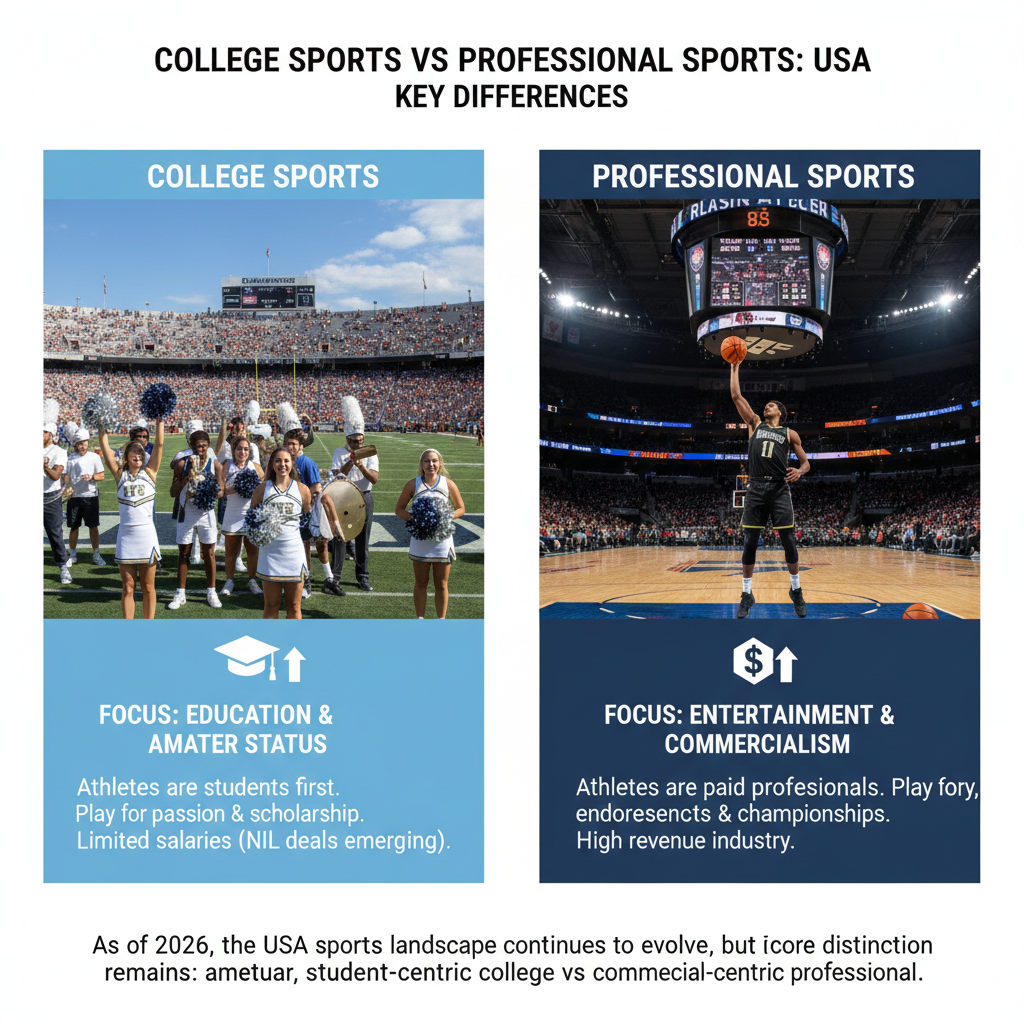
The roar of the crowd is deafening in both arenas. Whether it’s the marching band blaring a fight song at a Saturday football game or the pyrotechnics launching during player introductions on a Sunday, the passion for sports in the United States is universal. However, beneath the surface of touchdowns, slam dunks, and home runs lies a vast divide between the collegiate and professional levels.
For fans, the difference might seem subtle—a variation in jersey designs or the location of the three-point line. But for the athletes, coaches, and administrators involved, the two systems operate in entirely different universes. One is built on the foundation of education and tradition, while the other is a strictly commercial enterprise driven by profit and entertainment value.
Understanding these distinctions is crucial, not just for aspiring athletes navigating their careers, but for fans trying to grasp the changing landscape of American athletics. From the explosion of Name, Image, and Likeness (NIL) deals to the grueling demands of an 82-game season, let’s explore the key differences between college and professional sports.
Overview of College Sports vs. Professional Sports
At its core, the distinction lies in the primary purpose of the organization. College sports are technically amateur athletics governed by the National Collegiate Athletic Association (NCAA) and other smaller bodies. The theoretical goal is to provide student-athletes with an education while they compete, using sports as a vehicle for personal development and school spirit.
Professional sports, such as the NFL, NBA, MLB, and NHL, are commercial businesses. The primary objective is to generate revenue through ticket sales, broadcasting rights, and merchandise. The athletes are employees, the coaches are managers, and the teams are franchises often owned by billionaires or investment groups.
While the lines are blurring due to modern legislation, this fundamental difference dictates everything from how players are acquired to how the seasons are structured.
Organizational Structure
The structural hierarchy of these two worlds sets the stage for how they operate daily.
NCAA and College Conferences
College sports are decentralized. The NCAA sets the broad rules regarding eligibility and competition, but the real power lies within the conferences (like the SEC, Big Ten, or ACC). Universities are members of these conferences, and they compete for regional pride and national championships. The “owners” are the universities themselves, represented by athletic directors and university presidents who answer to a board of trustees.
Professional Leagues and Franchises
Professional sports are centralized monopolies. The NFL or NBA acts as the governing body, led by a commissioner who works on behalf of the team owners. There is no “promotion and relegation” like in European soccer; the franchises are fixed entities. The goal is competitive balance to maximize entertainment value, enforced through salary caps and draft orders—concepts that don’t exist in the same way at the collegiate level.
Athlete Compensation and Benefits
Perhaps the most discussed topic in modern sports is how the talent gets paid. This area has undergone a seismic shift in the last few years.
College Athlete Compensation
For decades, the “deal” for college athletes was simple: you play, and we pay for your school. Compensation came in the form of scholarships covering tuition, room, board, and books. Athletes also receive access to elite coaching, nutrition, and medical care.
However, the introduction of Name, Image, and Likeness (NIL) rules changed the landscape. While schools still cannot directly pay athletes a salary for playing (pay-for-play), athletes can now sign endorsement deals with third parties. A star quarterback might drive a sponsored car or promote a local restaurant. While this brings college closer to the pros, the income is not guaranteed by the league or the team; it is market-dependent.
Professional Athlete Compensation
Professional athletes are salaried employees. They sign contracts that specify exactly how much they will earn for their labor. These contracts are often negotiated by agents and protected by players’ unions (like the NBPA or NFLPA).
Beyond the base salary, pros earn performance bonuses, signing bonuses, and substantial endorsement money that isn’t tied to NIL regulations. They also receive benefits typical of high-level employment, including pensions, 401(k) matching, and comprehensive healthcare that can extend after retirement.
Level of Competition
There is a popular saying in scouting circles: “Men amongst boys.” This phrase highlights the sheer physical disparity between the two levels.
Talent Development Pathways
College is a development ground. You have 18-year-old freshmen competing against 22-year-old seniors. The gap in physical maturity, speed, and game knowledge can be massive within a single team. The talent pool is also diluted; there are over 100 Division I football teams, meaning elite talent is spread out.
Experience and Physical Demands
In the pros, everyone was a college star. The worst player on an NFL roster was likely the best player his college team had seen in years. Professional athletes are fully grown adults who have dedicated their lives to physical conditioning. The game moves significantly faster, the windows for passing are smaller, and the physical toll is much higher. Mistakes that go unpunished in college result in turnovers or losses in the pros.
Training, Facilities, and Resources
The resources available to athletes have skyrocketed at both levels, but the intent behind them differs.
College Athletic Programs
Top-tier college programs act as recruiting tools. Universities build lavish locker rooms, barbershops, and waterfalls in their recovery centers to entice 17-year-old recruits to sign a letter of intent. The facilities are designed to impress as much as they are to train.
Pro-Level Performance Infrastructure
Professional facilities are purely functional and state-of-the-art. While they are luxurious, the focus is entirely on performance optimization and injury prevention. Pros have access to teams of data scientists, biomechanists, and specialized nutritionists that even top colleges might not afford. The goal isn’t to look cool; it’s to keep a multimillion-dollar asset on the field.
Eligibility and Career Length
Job security is a major differentiator. In one system, you are guaranteed an end date; in the other, you have to fight to stay employed every day.
Age and Eligibility Rules
College eligibility is finite. Generally, an athlete has four years of eligibility to compete within a five-year window (the “five to play four” rule). Once that time is up, their college career is over, regardless of how talented they are. This creates a constant turnover of rosters, forcing coaches to recruit new teams annually.
Career Timelines and Longevity
Professional careers can last as long as the athlete can perform. Tom Brady played into his 40s; LeBron James is defying age in the NBA. However, the average pro career is brutally short—often less than four years in leagues like the NFL—due to the intense competition. In the pros, you can be cut, traded, or demoted to a minor league at any moment.
Academic vs. Athletic Balance
The lifestyle of the athlete varies wildly depending on whether they have to carry a backpack to class.
Education Requirements in College Sports
The term “student-athlete” is strictly enforced. College players must maintain a specific GPA and progress toward a degree to remain eligible to play. They have to balance 6:00 AM workouts with Biology 101 and evening study halls. This dual responsibility creates a unique pressure cooker that professional athletes do not face.
Full-Time Athletic Focus in Pro Sports
For professionals, the sport is the 9-to-5 job (and often the 5-to-9 job, too). Their day consists of film study, practice, treatment, and media appearances. There are no midterms to study for. This allows pros to dedicate 100% of their mental and physical energy to mastering their craft.
Rules, Scheduling, and Season Structure
The logistics of the games themselves create different rhythms for players and fans.
Game Rules and Season Length Differences
Rules often vary to accommodate skill levels. In college football, a player is down by contact even if no defender touches them; in the NFL, they can get back up. In college basketball, the shot clock is longer, and the halves are structure differently than the NBA’s quarters.
The schedule is the biggest shock for rookies. A college basketball team plays about 30-35 games. An NBA team plays 82 regular-season games plus playoffs. A college baseball schedule is around 56 games; MLB players endure a 162-game marathon. This volume requires a different approach to energy conservation and recovery.
Travel and Recovery Demands
College travel is usually regional, often on buses or charter flights, returning to campus for Monday classes. Professional travel is cross-country and constant. The “red-eye” flight to the next city is a staple of the pro lifestyle, placing a premium on sleep science and recovery management.
Media Exposure and Fan Engagement
The emotional connection between the team and the fan drives the business model.
College Rivalries and Traditions
College sports are tribal. Fans root for a team because they went to school there or because their family has for generations. The atmosphere is defined by marching bands, student sections, and deep-seated traditions. The marketing focuses on history and loyalty.
Professional Branding and Global Reach
Professional sports marketing focuses on stars. The NBA markets individual players like Steph Curry or Giannis Antetokounmpo to a global audience. The reach is international, with games played in London, Mexico City, and Paris. While city pride exists, fans are often more critical, and loyalty can shift if the team is poorly managed.
Financial Models and Revenue Generation
Money makes the world go round, but the flow of cash differs significantly.
College Athletics Revenue Distribution
The NCAA and university athletic departments are non-profits. Revenue generated from football and basketball—the “revenue sports”—is used to fund the other varsity sports (like swimming, golf, or tennis) that rarely make a profit. It creates an ecosystem where the successful teams subsidize the entire athletic department.
Professional League Profit Models
Pro teams are for-profit businesses. Revenue is shared between the owners and the players based on collective bargaining agreements. If a team makes a profit, that money goes into the owner’s pocket or is reinvested into the franchise. There is no obligation to fund other sports or local initiatives unless it’s part of a marketing or charity strategy.
Risk, Pressure, and Athlete Well-Being
The mental and physical toll of high-level athletics is universal, but the sources of stress are distinct.
Performance Pressure Differences
In college, the pressure often comes from balancing academics with expectations from alumni and coaches. Losing a game feels like letting down a community. In the pros, the pressure is financial and employment-based. One bad season can cost a player millions of dollars in future contracts.
Injury, Mental Health, and Job Security
An injury in college is tragic, but the scholarship is usually honored. An injury in the pros can end a career and income stream instantly. This creates a high-stress environment regarding job security. Professional leagues have begun investing heavily in mental health resources, recognizing the isolation and stress that come with the spotlight.
Pathways from College to Professional Sports
How does an athlete move from one world to the other?
Draft Systems and Scouting
The Draft is the primary mechanism. Scouts spend years analyzing college tape, interviewing coaches, and attending “Pro Days” to evaluate talent. Being drafted is the dream, but it’s statistically unlikely for most college athletes (less than 2% go pro in major sports).
Alternative Routes to Pro Leagues
Recently, alternatives have emerged. The NBA G-League Ignite (though recently shut down) and Overtime Elite offered routes for high schoolers to bypass college. In baseball, players can go straight from high school to the minor leagues. However, college remains the primary feeder system for the NFL and NBA.
Pros and Cons for Athletes
College Sports Pros and Cons
Pros:
- Free education and a degree.
- Strong sense of community and unmatched atmosphere.
- NIL opportunities allow for earnings without losing amateur status.
- Development time to mature before hitting the pro level.
Cons:
- Strict schedules balancing school and sport.
- No guaranteed salary; income depends on marketability (NIL).
- Limited control over schedule and coaching changes.
Professional Sports Pros and Cons
Pros:
- Significant financial rewards and generational wealth.
- Ability to focus 100% on the sport.
- Access to the best resources and medical care in the world.
- Unions provide protection and benefits.
Cons:
- Extremely high job insecurity.
- Brutal physical toll and long seasons.
- Public scrutiny and lack of privacy.
How NIL Has Changed College Sports
Name, Image, and Likeness has fundamentally altered the comparison. Previously, the line was clear: pros got paid, college kids didn’t. Now, top college quarterbacks can earn millions, sometimes more than late-round draft picks in the NFL.
This has impacted recruiting, with schools forming “collectives” to pool money for athletes. It has also led to the “transfer portal” explosion, where athletes switch schools to find better playing time or NIL deals, mimicking professional free agency. The line between the two worlds is thinner than ever.
Which Is Better for Athletes?
There is no definitive answer. For an athlete who needs physical development or values a degree, college is the superior path. The structure provides a safety net. For the generational talent ready to compete immediately, the professional route offers financial security and a faster start to a career. Ultimately, the choice depends on the individual’s goals, maturity, and specific sport.
FAQs – College Sports vs Professional Sports
What is the main difference between college and pro sports?
The main difference is that college sports are tied to educational institutions where athletes are students first, while professional sports are commercial businesses where athletes are paid employees.
Do college athletes get paid?
Universities do not pay athletes a salary. However, under NIL (Name, Image, Likeness) rules, college athletes can earn money from third-party endorsements, sponsorships, and autograph signings.
Is college sports harder than professional sports?
In terms of skill and physical demand, professional sports are harder because every player is an elite talent. However, college sports can be challenging due to the requirement of balancing full-time academics with athletics.
Can athletes skip college for pro leagues?
It depends on the sport. In the NBA, a player must be one year removed from high school (the “one-and-done” rule). In the NFL, players must be three years out of high school. In MLB and NHL, players can be drafted directly from high school.
How has NIL changed college athletics?
NIL has allowed college athletes to earn money, created a form of “free agency” through the transfer portal, and made recruiting more competitive as schools with wealthy donor collectives can offer better financial opportunities to recruits.
Moving the Goalposts
Whether you prefer the pageantry of a college bowl game or the precision of the NBA playoffs, understanding the mechanics behind the scenes enriches the viewing experience. As laws change and player power grows, the gap between these two worlds may continue to shrink, but the fundamental spirit of each—school pride vs. professional excellence—will likely remain the defining characteristic of American sports culture.