





How Refereeing Technology Is Improving Accuracy USA

Introduction to Refereeing Technology
Refereeing technology refers to the range of tools and systems employed to assist officials in making accurate decisions during sports events. The significance of these advancements in officiating cannot be overstated, as they enhance the overall fairness and integrity of competitive sports. Over recent decades, the integration of technology into sports officiating has transformed how referees and umpires operate, moving away from purely human judgment to a reliance on data and visual aids.
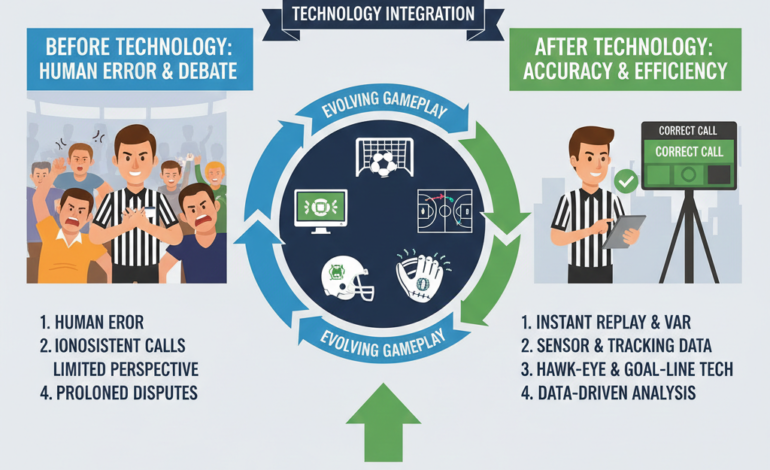
Historically, officiating relied solely on the subjective perspectives of referees, which often led to controversies and disputes among players, coaches, and fans. As sports evolved, so too did the demands for greater accuracy and accountability. The advent of technology in refereeing began with fundamental innovations such as instant replay and slow-motion capability, which allowed officials to review contentious calls. This represents a significant shift in how sports are officiated, providing referees the ability to ensure their decisions are as accurate as possible.
In contemporary sports, refereeing technology encompasses a variety of sophisticated tools, including Video Assistant Referee (VAR) systems in soccer, Hawk-Eye in tennis, and goal-line technology in football, among others. Each of these innovations aims to reduce human error and improve the quality of officiating across platforms. In addition to visual aids, data analytics plays a crucial role in evaluating player performance and informing refereeing decisions. This ongoing technological evolution not only augments the refereeing process but also enhances the overall spectator experience by providing clarity and transparency in officiating decisions.
The Need for Accuracy in Sports Officiating
Accurate officiating is paramount in sports as it directly impacts the outcome of games, the performance of teams, and the overall experience for fans. In a landscape where every point and play can be contested, the necessity for precision in judgment is increasingly under scrutiny. Wrong calls can lead to not only disappointment and frustration among teams but also to broader implications for tournaments and championships. A single inaccurate decision might affect a team’s trajectory, leading to losses that eliminate them from competitive standing, or worse, tarnish their reputation.
Human error in officiating is an inevitable issue in the fast-paced environment of sports. For example, the 2010 World Cup match between the USA and Algeria is often recalled due to a controversial call concerning a potential goal that could have shifted the match’s outcome. Such instances demonstrate that even minor mistakes or differing interpretations of the rules can create a ripple effect that questions the integrity of the officiating process.
Advancements in technology strive to mitigate these discrepancies in sports officiating. Tools such as instant replay systems and technological innovations like VAR (Video Assistant Referee) have been implemented in various sports to enhance the accuracy of calls and reduce subjective bias. These technologies allow officials to review decisions and ensure that the judgment is as accurate as possible. Not only does this enhance the credibility of officiating, but it also builds trust with players and fans alike.
With the rise of technology in sports, discussions surrounding fairness and equality have also gained momentum. The aim is to move toward a system where decisions are less influenced by the human element, thereby fostering a level playing field. As sports continue to evolve, the integration of technology into officiating stands as a clear necessity, aimed at safeguarding the integrity of the game and enhancing the overall experience for everyone involved.
Technological Innovations in Refereeing
The realm of sports officiating has encountered a transformative shift due to the integration of advanced technology. Innovations such as the Video Assistant Referee (VAR), Hawk-Eye, and goal-line technology have been pivotal in enhancing the accuracy of calls made by referees across various sports. Each of these technologies contributes uniquely to the officiating landscape, ensuring fair play and minimizing human error.
Video Assistant Referee (VAR) is a system that has gained prominence in soccer, providing referees with support when making critical decisions. A team of officials reviews video footage to assist in decisions regarding goals, penalty calls, direct red card incidents, and mistaken identities. The presence of VAR has instigated debates over its efficiency and impact on the flow of the game, yet its implementation has undoubtedly aimed to improve the accuracy of officiating.
Another noteworthy innovation is Hawk-Eye, which employs multiple cameras to track the trajectory of the ball in real time. Originally developed for tennis, Hawk-Eye has expanded its applications to various sports such as cricket and soccer. In soccer, it reinforces decision-making concerning whether the ball crosses the goal line, providing clear evidence and removing ambiguity. The precise tracking capabilities of Hawk-Eye enable referees to make informed decisions, significantly enhancing the overall officiating process.
Goal-line technology represents yet another advancement, specifically designed to ascertain the exact moment a ball crosses the goal line. This technology utilizes sensors and high-speed cameras to deliver instantaneous and accurate results. By removing the guesswork from one of the most critical aspects of soccer, goal-line technology contributes significantly to accurate officiating, ensuring that every goal is appropriately recognized.
Collectively, these technological innovations are fostering a more precise and fair sporting environment, ultimately driving the evolution of refereeing standards. The continuous improvement and integration of these technologies aim to mitigate errors and uphold the integrity of the game.
Case Studies: Successful Implementation of Technology
In recent years, several major leagues in the USA have adopted advanced officiating technologies that have revolutionized game accuracy and fairness. One prominent example is the National Football League (NFL), which integrated Instant Replay Review in 1986. This system allows coaches to challenge certain calls made by officials, significantly reducing the number of incorrect calls. A case study from the 2018 NFC Championship Game highlights this; a controversial non-call on pass interference led to widespread criticism. After reviewing the situation, the NFL expanded its use of technology in officiating to include fouls like pass interference in the future, illustrating the importance of leveraging technology for accurate decision-making.
In the realm of basketball, the National Basketball Association (NBA) has embraced technology through the use of the Replay Center. This central hub allows referees to review crucial plays, such as buzzer-beaters or fouls. A notable instance occurred during the 2019 playoffs when a last second shot from a player was initially deemed unsuccessful, only for a subsequent review to confirm it was indeed a three-pointer, leading to a changed outcome. Feedback from players and coaches after these critical reviews has generally been positive, emphasizing technology’s role in enhancing the game’s integrity.
Moreover, Major League Soccer (MLS) introduced Video Assistant Referee (VAR) in 2017. One case that stands out took place during the 2019 MLS Cup. A contentious penalty decision was reviewed via VAR, which ultimately reversed the on-field call, ensuring a fairer contest. Players and fans expressed a mix of relief and skepticism. While some argued that VAR interrupted the flow of the game, most acknowledged its importance in maintaining accuracy in officiating decisions.
These case studies exemplify how technology is being implemented effectively in officiating across major leagues, reinforcing the principle of fair play in sports.
Challenges and Limitations of Refereeing Technology
The integration of refereeing technology in sports, while promising enhanced accuracy, presents a series of challenges and limitations that cannot be overlooked. One of the primary concerns is the financial burden associated with the implementation of advanced technology. Many sports organizations, particularly at the amateur and semi-professional levels, may lack the financial resources needed to purchase and maintain high-quality refereeing technology systems. This cost can be a significant barrier to widespread adoption, creating disparities between well-funded professional leagues and grassroots organizations.
Moreover, there is the issue of reliance on technology that could potentially undermine the authority and judgement of referees. When technology is seen as the definitive decision-maker, it may lead to lessened respect for human referees, especially in scenarios where technology may not be perfectly accurate or fails to provide a clear answer. This shift in dynamics can affect the morale and decision-making power of referees as they navigate their roles on the field.
Technical failures add another layer of complexity to the use of refereeing technology. Instances of malfunctions, software glitches, or inaccuracies can lead to controversial decisions that further shake the trust in these technological systems. For example, a malfunctioning camera system interpreting a play inaccurately can provoke intense debates among players, coaches, and fans alike, potentially damaging the sport’s integrity. As a result, the implementation of refereeing technology must be accompanied by a robust framework to address these potential issues, ensuring that sports continue to thrive amid technological advancements.
The Role of Training and Adaptation for Referees
As the landscape of sports officiating evolves with technological advancements, the training of referees has become paramount in ensuring accurate decision-making on the field. The integration of technology such as Video Assistant Referee (VAR), goal-line technology, and other electronic tools necessitates a comprehensive approach to referee training. This training equips officials to seamlessly incorporate these innovations into their daily practice, thereby enhancing officiating accuracy.
The implementation of these technologies requires referees to not only understand how to utilize them effectively but also to adapt their decision-making processes accordingly. Workshops and training sessions focusing on technology are becoming standard practice within officiating bodies. These sessions emphasize the importance of analysis, real-time feedback, and communication skills that are crucial when making critical decisions. By familiarizing themselves with technological tools, referees can develop a clearer understanding of how these innovations influence the game, leading to more confident and informed officiating.
Moreover, adaptation to technology is not merely about technical proficiency; it also involves evolving the mindset of referees. As officials begin to rely on these tools, they must balance their authority with technological inputs. This requires a shift in perspective, as referees cannot simply defer all crucial decisions to technology but must learn to integrate these insights while maintaining their leadership on the pitch. Continuous professional development programs have thus become instrumental in fostering this balance. As referees work to enhance their skills, they solidify their roles within the dynamic nature of modern sports, preserving the integrity of the game while employing the benefits that technology affords.
Comparative Analysis: Technology in Various Sports
In the realm of sports officiating, the introduction of technology has fundamentally transformed how games are managed and how decisions are made. Different sports in the USA employ various types of refereeing technology, leading to a spectrum of methodologies and levels of acceptance among players and fans. Analyzing how sports like basketball, football, and soccer have integrated technological solutions provides insight into the evolution of officiating practices.
In basketball, the integration of technology is prominently demonstrated through the use of advanced replay systems. The NBA employs a video review system that allows officials to reassess crucial calls, such as three-point line violations or fouls. This technology is widely accepted by players and fans alike, largely because it contributes to the accuracy of game outcomes. The use of the Instant Replay system has led to a decrease in contentious calls, thus enhancing the overall fairness of play.
Conversely, in American football, the application of technology has faced mixed reactions. The NFL utilizes sophisticated replay mechanisms, including the Coach’s Challenge system, allowing coaches to contest specific calls. Although this technology seeks to improve the accuracy of decisions, debates around the pace of the game and the frequency of interruptions persist. Fans often express frustration during long reviews, revealing a paradox where increased accuracy can disrupt game momentum.
Soccer, too, is embracing technological innovations such as Video Assistant Referee (VAR) systems. The implementation of VAR has sparked considerable debate among enthusiasts regarding its impact on the game’s flow and the integrity of the officiating process. While some laud VAR for minimizing human error, others criticize its influence on game dynamics, thus revealing a divide in its acceptance across different demographics.
Each sport’s unique approach to refereeing technology reflects not only the sport’s culture but also its audience’s appetite for modernization. As technology continues to evolve, it will be interesting to observe how these systems adapt and find acceptance among the players and fans they serve.
Future Trends in Refereeing Technology
The future of refereeing technology is poised for fascinating advancements that promise to enhance accuracy and fairness in sports officiating. As artificial intelligence (AI) continues to evolve, its integration into officiating systems is anticipated to grow significantly. AI-powered algorithms can analyze vast amounts of data in real time, allowing for more precise decision-making processes. These capabilities could lead to technologies that not only assist referees but also offer predictive analytics, enabling officials to anticipate potential infractions before they occur.
Machine learning, a subset of AI, stands to revolutionize the way referees are trained and supported in their roles. By continuously learning from past game footage and decision outcomes, machine learning systems can provide feedback and recommendations to referees based on previous events. This development could result in a new era of officiating where human error is minimized, and calls are supported by data-driven insights. Additionally, real-time performance metrics could be generated, allowing referees to review their decision-making effectiveness after each game.
Video analytics also plays a critical role in the future of officiating. Enhancements in camera technology and imaging capabilities will enable more angles and clearer views of plays. Systems that automatically highlight potentially contentious moments in a game could significantly improve the review process. Furthermore, innovations like augmented reality (AR) may offer referees immersive tools to visualize the dynamics of a play, thereby aiding in their decision-making.
In summary, the future of refereeing technology is looking vibrant and innovative, with advancements in AI, machine learning, and video analytics leading the charge. These developments promise not only to improve the accuracy of officiating but also to foster trust in the officiating process, ultimately enhancing the overall sports experience for players and fans alike.
Conclusion: The Future of Accuracy in Sports Officiating
As we look towards the future of sports officiating in the USA, it becomes increasingly clear that the integration of technology is transforming the landscape. Enhanced accuracy through technologies like video assistant referee (VAR), goal-line technology, and real-time analytics has significantly impacted the way sports are officiated. These advancements not only improve the reliability of decision-making during critical moments but also foster greater accountability within various sporting arenas.
Key points discussed emphasize the importance of these technological innovations, which aim to eliminate human error and bring fairness to the game. Athletes, teams, and fans alike benefit from the precision offered by these tools, thus enhancing their overall experience. However, it is essential to recognize that technology serves as an aid rather than a replacement. The human element of officiating remains vital, as referees and officials provide context and interpretation that machines cannot fully replicate.
Striking a balance between technological support and the knowledge and intuition of human referees is paramount for the integrity of sports. Each decision made on the field still requires a nuanced understanding of the game, an area where human referees excel. Looking ahead, it is crucial for sports organizations to carefully evaluate how best to incorporate these technologies while ensuring that the essence of the sport is preserved.
In conclusion, the future of accuracy in sports officiating is promising, characterized by the convergence of human expertise and technological advancements. This harmonious relationship has the potential to create a more transparent and equitable sporting environment, thereby enriching the experience for all stakeholders involved in the dynamic world of sports.