




Evolution of Sports Training Methods in the USA
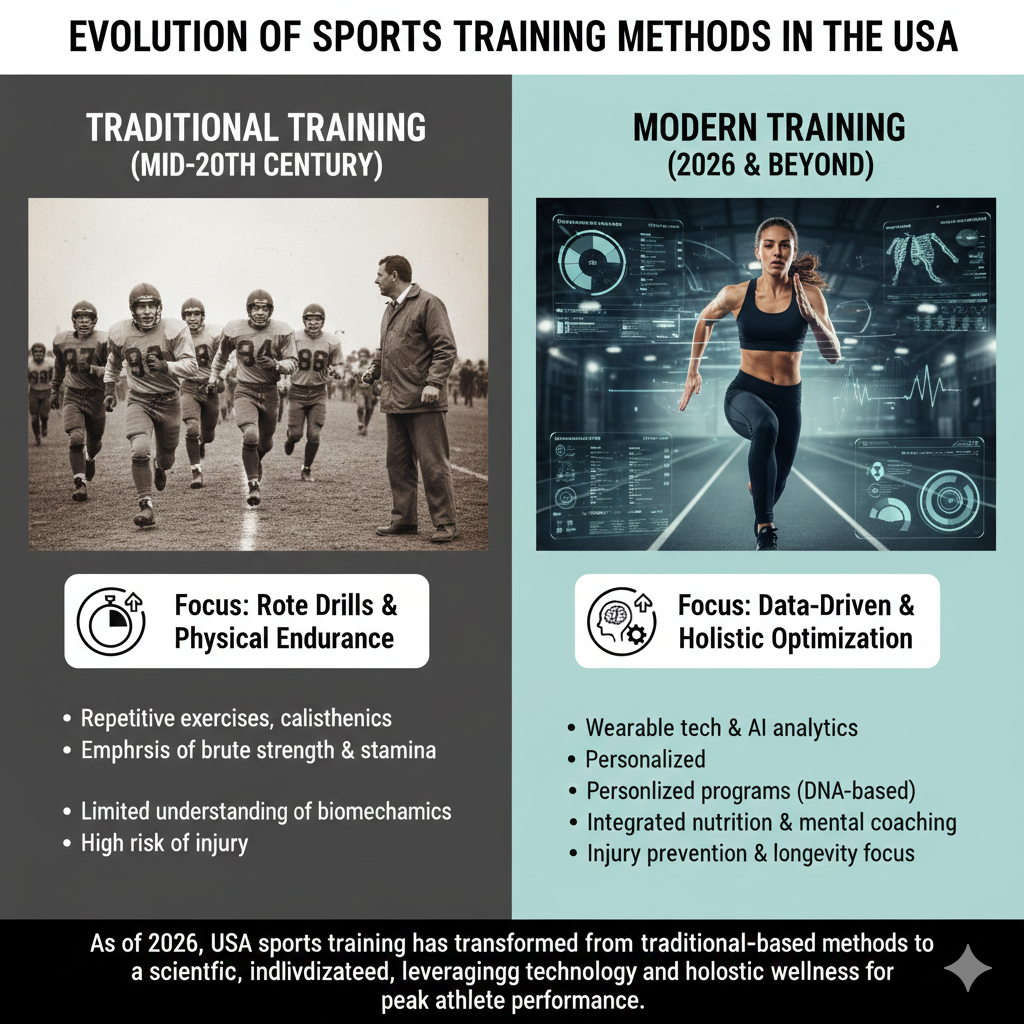

Picture a football training camp in the 1960s. The scene is gritty, almost cinematic. Players are running endless laps under a scorching sun, denied water breaks because dehydration was mistakenly equated with mental toughness. The coach’s word was law, based entirely on gut feeling and tradition. If you weren’t vomiting, you weren’t working hard enough.
Fast forward to a modern NFL facility. The atmosphere is clinically precise. Players wear GPS vests that track their top speed and total distance to the millimeter. Nutritionists customize post-workout shakes based on an athlete’s sweat composition. Recovery involves cryotherapy chambers rather than just “walking it off.”
The journey of sports training in the United States is a fascinating mirror of our broader cultural shift from industrial grit to information-age precision. It is a story of how science, technology, and a deeper understanding of the human body have revolutionized the way athletes prepare, perform, and recover. We have moved from an era of survival of the fittest to an era of engineering the fittest. This evolution hasn’t just changed the scoreboard; it has fundamentally altered the limits of human potential.
What Are Sports Training Methods?
At its core, a sports training method is a systematic approach to improving athletic performance. It is the roadmap an athlete follows to get from where they are to where they need to be. These methods encompass everything a player does off the field to prepare for what happens on it.
Historically, training was often viewed as simply “practicing the sport.” A basketball player played basketball; a runner ran. However, modern training methods have dissected performance into constituent parts: strength, speed, agility, endurance, flexibility, and mental resilience.
The purpose of these methods is twofold: performance enhancement and longevity. It is about jumping an inch higher or running a split-second faster, but it is also about ensuring the athlete’s body can withstand the rigors of the season without breaking down. In the high-stakes world of American sports, where contracts run into the hundreds of millions, training methods are the insurance policy on that investment.
Early Sports Training in the USA
For much of the early 20th century, American sports training was defined by simplicity and severity. The prevailing philosophy was one of general conditioning. Boxers, baseball players, and football stars all did roughly the same things: calisthenics, long-distance running, and basic drills.
Scientific input was virtually non-existent. Training was an oral tradition passed down from one generation of coaches to the next. If a coach won a championship in 1950 by making his team push trucks across a parking lot, other coaches copied it, assuming that was the secret sauce.
There was also a pervasive fear of “being muscle-bound.” For decades, baseball scouts and basketball coaches forbade their athletes from lifting weights, believing that increased muscle mass would limit flexibility and ruin shooting mechanics. This era was characterized by the “more is better” mentality. Rest days were viewed as a sign of weakness, and pain was simply something to be ignored.
Rise of Structured Strength and Conditioning
The tide began to turn in the late 1960s and early 1970s, largely driven by American football. A pivotal moment occurred at the University of Nebraska, where Boyd Epley became the first paid strength and conditioning coach in the NCAA. Epley challenged the old myths. He proved that a stronger athlete was a faster, more explosive athlete.
When Nebraska started dominating opponents physically, the rest of the country took notice. The adoption of weight training spread rapidly from the gridiron to the hardwood and the diamond. By the 1980s, the weight room became a sanctuary.
This era introduced the concept of sport-specific conditioning. Coaches realized that a linebacker requires a different energy system than a wide receiver. Off-season training programs became mandatory. The days of athletes selling cars or working construction during the off-season began to fade, replaced by year-round dedication to physical development.
Influence of Sports Science
As the 20th century drew to a close, the laboratory doors swung open. Exercise physiology and biomechanics moved from academic textbooks to the locker room. The question shifted from “How much can you lift?” to “How efficiently do you move?”
Sports scientists began analyzing the physics of movement. In baseball, high-speed cameras broke down a pitcher’s mechanics to optimize velocity and reduce elbow strain. In track and field, wind tunnel testing helped refine posture.
This marked the beginning of evidence-based programming. Coaches could no longer rely solely on intuition; they needed data. Lactate threshold testing, VO2 max tests, and force plate analysis provided objective metrics. Training became a prescription, dosed specifically for the individual athlete’s needs.
Evolution of Training by Decade
The philosophy of training has shifted distinctively with each passing decade, reflecting the trends and knowledge of the time.
1980s–1990s: Strength and Power Focus
The 80s and 90s were the era of mass. Heavily influenced by the golden age of bodybuilding, training programs prioritized hypertrophy—making muscles bigger. Athletes across all sports bulked up. The focus was on absolute strength: bench presses, squats, and deadlifts. While this produced powerful athletes, it often neglected agility and flexibility, leading to stiff movement patterns.
2000s: Functional and Sport-Specific Training
The new millennium brought a correction to the bulk-building era. The buzzword became “functional training.” Led by pioneers like physical therapist Gray Cook, the industry realized that isolated muscle strength didn’t always translate to the field.
Training shifted toward compound movements that mimicked the chaos of sport. Stability balls, resistance bands, and balance trainers filled gyms. The goal was to train movements, not just muscles. Core stability became a central pillar, with the understanding that power is generated from the center of the body outward.
2010s–2020s: Data and Recovery Integration
The most recent shift has been toward efficiency and recovery. With the rise of “Moneyball” analytics in front offices, a similar data revolution hit the training room. “Load management” became a standard term. Teams realized that grinding athletes into the ground during practice led to poor performance on game day. The focus shifted to the minimum effective dose—getting the maximum result with the least amount of wear and tear.
Technology’s Role in Modern Sports Training
If you look at a modern NBA bench or an NFL sideline, you see iPads everywhere. Technology has become the third coach.
Wearable technology has been the biggest game-changer. Devices like Whoop straps, Oura rings, and Catapult GPS vests provide 24/7 biometric feedback. Coaches know exactly how far a player ran, their heart rate variability, and their sleep quality. This eliminates the guesswork. A coach doesn’t have to ask, “Are you tired?” The data already says yes.
Video analysis has also evolved from grainy VHS tapes to AI-driven motion capture. Systems like Hawk-Eye can track skeletal movement in real-time, allowing coaches to make micro-adjustments to a batter’s swing or a golfer’s drive instantly.
Recovery and Injury Prevention Advances
Perhaps the greatest evolution has been the rebranding of recovery. It is no longer seen as “time off”—it is seen as “active preparation.”
Regeneration techniques have exploded. Professional teams employ entire staffs dedicated to mobility and flexibility. Yoga and Pilates, once dismissed by tough-guy coaches, are now staples in the NFL and MLB.
Sleep and nutrition have been integrated into the training lifecycle. Teams hire sleep consultants to manage travel schedules and circadian rhythms. Nutrition has moved beyond simple calorie counting to timing meals for optimal glycogen replenishment and muscle protein synthesis. The modern athlete understands that you don’t get stronger when you train; you get stronger when you recover from training.
Mental Training and Performance Psychology
The barrier between physical and mental training has dissolved. In the past, sports psychology was often stigmatized, reserved for athletes who had “the yips” or were “choking.” Today, it is a proactive tool for performance enhancement.
Mindset training focuses on visualization, focus, and resilience. Athletes like LeBron James and Michael Phelps have openly discussed the importance of mental conditioning. Techniques such as mindfulness and meditation are used to manage the immense pressure of the social media age. Athletes train their brains to enter “flow states” on command, regulating their nervous systems to stay calm in high-stakes moments.
Evolution in Youth and Amateur Training
The trickle-down effect of professional training has drastically changed youth sports. Long-Term Athlete Development (LTAD) models are now used to guide children through appropriate stages of growth, prioritizing skill acquisition over winning at all costs.
However, this has also led to the controversy of early specialization. In the past, kids played football in the fall, basketball in the winter, and baseball in the spring. Today, the pressure to secure college scholarships has led many to play one sport year-round. While this increases skill in specific areas, modern research warns it also increases burnout and overuse injuries, leading to a pushback promoting multi-sport participation for better overall athleticism.
Differences Between College and Professional Training
While the methodologies are similar, the constraints differ significantly between NCAA and professional levels.
College programs are strictly regulated by the NCAA regarding how many hours an athlete can train per week. This forces strength coaches to be incredibly efficient, packing high-intensity work into small windows.
At the professional level, training is a full-time job. With no class schedules or hour restrictions, training can be spread out. This allows for greater specialization and, crucially, lower intensity over longer durations. A pro athlete might spend four hours at the facility, but two of those hours are massage, stretching, and film study.
Benefits of Modern Training Methods
The proof of this evolution is visible on the field. The primary benefit is improved performance consistency. Athletes are faster and stronger than ever before. Records that stood for decades are falling regularly.
More importantly, careers are longer. In previous eras, a running back was considered “old” at 28. Today, we see athletes performing at elite levels well into their mid-30s and even 40s (like Tom Brady or LeBron James). Modern methods preserve the joints and tissues, allowing talent to shine longer.
Finally, injury rates for preventable issues—like non-contact muscle strains—are being managed better through data monitoring, keeping stars on the field where fans want them.
Challenges in Modern Sports Training
Progress is not without its pitfalls. One major challenge is the risk of “paralysis by analysis.” With so much data available, coaches and athletes can sometimes overthink movements that should be instinctual.
There is also the risk of misinterpreting data. Just because a sensor says an athlete is fatigued doesn’t always mean they can’t perform. The “human element”—heart, grit, and adrenaline—cannot be quantified by an algorithm.
Furthermore, the intensity of youth training has led to an increase in overuse injuries, such as Tommy John surgery becoming common in high school pitchers. The quest for optimization can sometimes push the human body past its biological limits too early.
Future of Sports Training in the USA
The future lies in hyper-personalization. We are moving toward a world where genetic profiling could dictate training loads. AI-driven insights will likely become more predictive, telling a coach that a player is 15% more likely to tear a hamstring today based on their sleep data and yesterday’s workload, prompting a customized practice schedule.
Virtual reality (VR) will also play a larger role, allowing athletes to take “mental reps” without physical wear and tear. As technology advances, the line between biology and engineering will continue to blur, ushering in a new age of the super-athlete.
FAQs – Evolution of Sports Training Methods
How have sports training methods changed over time?
Training has moved from a generic, high-volume approach based on tradition and “toughness” to a scientifically backed, highly specialized, and data-driven methodology that prioritizes recovery and efficiency alongside effort.
Why is modern training more effective?
It is built on evidence rather than guesswork. By understanding biomechanics, nutrition, and physiology, coaches can target specific adaptations in the body, eliminating wasted energy and reducing the risk of injury.
What role does technology play in sports training?
Technology acts as a feedback loop. Wearables, GPS tracking, and video analysis provide objective data on an athlete’s workload and recovery status, allowing for precise adjustments to training programs.
Are modern athletes fitter than past athletes?
Generally, yes. While past athletes were incredibly tough, modern athletes benefit from better nutrition, advanced medicine, and training that optimizes human performance. Records in speed and strength continue to break, suggesting a higher peak physical standard.
Will technology replace traditional coaching?
Unlikely. Technology provides the information, but coaching requires the wisdom to apply it. The motivation, mentorship, and psychological management provided by a human coach remain essential for athlete success.
The Legacy of Sweat and Science
The evolution of sports training in the USA is a testament to our relentless pursuit of excellence. We have come a long way from the dust bowls and salt tablets of the past. Today’s training facility is a fusion of a high-end gym and a medical laboratory.
Yet, despite the influx of silicon chips and spreadsheets, the heart of sports remains the same. The methods have changed, but the goal—to be faster, stronger, and better than the competition—remains eternal. As we look to the future, the challenge will be balancing the cold precision of science with the fiery, intangible spirit that makes sports worth watching. The next generation of legends will be built on this foundation, standing on the shoulders of the giants who ran laps so they could run numbers.